Tuesday, December 19, 2017

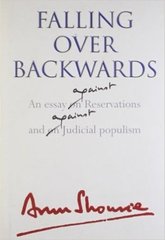
Falling over Backwards


Title: Falling over Backwards – An Essay on Reservations and on Judicial Populism
Author: Arun Shourie
Publisher: Rupa & Co, 2009 (First published 2006)
ISBN: 9788129109521
Pages: 378

When Prime Minister Vishwanath Pratap Singh announced that he was instituting reservation for Other Backward Castes (OBC) in government service in 1990, it was a bolt from the blue. Nobody had seen it coming and all hell broke loose as the country plunged into a series of violent protests, in which a few young men publicly immolated themselves to vent their anger at the supposed loss of jobs for forward castes. The backward classes which constituted 74 per cent of the population and the progressives among the upper castes welcomed the initiative, while quite understandably, a section of the people opposed it tooth and nail in parliament and law courts. The Supreme Court finally delivered its verdict in 1993. It upheld the constitutional validity of reservation for OBCs, but ruled that the well-off among them, christened the Creamy Layer, should be removed from its ambit. The country still follows that principle, while sporadic opposition to reservation continued. By the beginning of the present century, a new trend became noticeable. The upper castes also started the clamour for labeling themselves backward and accord reservations to them. The Jats have almost succeeded in getting what they wanted, while the Patidars of Gujarat are currently on the war path. Their logic is clear. With every judicial avenue closed for repealing reservation, and the political route impossibly difficult as the physical number of backward castes are far more numerous, the only thing they can hope for is to crash the gates, register all forward castes as backward and thus defeat the very purpose of granting reservation. Arun Shourie was the editor of the Indian Express when the Mandal agitation roiled the country. His fiery editorials and polemical essays added fuel to the fire. Shourie still retains his strident tone, even after all these years. This book contains his observations on reservation and the judicial support it had received. Terming those judges who ruled in its favour as activists and revolutionaries, he spits venom at the so-called judicial populism.

Shourie’s attack on the backward castes of India runs on all fronts. He treats them as non-entities, people with no talent to run government institutions, but who wrested concessions from pliable politicians owing to their electoral muscle. He quotes a letter Prime Minister Nehru wrote to state chief ministers in 1961 in which he reacted strongly against reservation which leads to inefficiency and second-rate standards. If we go for reservations on communal and caste basis, we swamp the bright and able people and remain second- or third-rate. Nehru adds that this way lays not only folly, but disaster. The parting shot is Nehru’s rhetorical question on how we could build the public sector or indeed any sector with second-rate people. Shourie builds on where Nehru has left off by questioning even the existence of backward castes. His argument is that the consciousness of caste came into being only when the British started counting castes in decennial census. Centuries of untouchability and caste oppression are just wished away by the author, who then takes the next arrow from the quiver. Article 16(4) of the Constitution of India, on which the entire scheme of reservation rests, envisages reservation on appointments and posts in favour of any backward class of citizens. The statute uses the term ‘class’ instead of ‘caste’ and about a quarter of the book is dedicated to push this idea down the readers’ throats. Several judgments of the apex court had clarified this issue long back. They held that the term ‘classes’ mentioned in the constitution indeed referred to ‘castes’. This is quite logical if a bit of thought is applied to the matter. The framers of the constitution wanted to reserve jobs for the backward sections lagged behind others. But, if they specifically mentioned castes in the constitution, that’d have been valid only for that period, as there is every chance that the plight of the backward castes might improve in the future and the need for reserving seats for them might become obsolete. Another group – need not exactly be a caste – may become backward by then and the provisions of this enabling clause in the constitution can be used to provide succor to them. We want the Constitution’s provisions to be applicable for a very long time to come. May be it is with this intent that the makers of the constitution used the generic term ‘class’ instead of the very specific ‘caste’? It is for the legislature to decide which group is backward and the duty of the judiciary is to review it. Both have done their jobs well, but the author accuses them of populism.

The book includes some prescient remarks that highlight the shrewdness of the author. He rightly surmises that if individuals and groups get rewarded on the basis of their being different from the rest, leaders will foment a politics that exacerbates the difference (p.33). That such an insightful scholar let go of absurd notions as well may surprise the readers. The hypothesis that castes in British India were in a state of flux is one such, especially with exodus of rural folk to the cities. Shourie’s point is that ‘in towns, it was quite easy for a low-caste person to claim a higher caste without any fear of detection’ (p.56). So, that’s it! The only way out for a person of backward castes to gain some dignity is to masquerade as a high-caste one in a far-off town! Elimination of the comparatively better off among the downtrodden communities has been a strong demand of all those who opposed reservations. Unfortunately, the passion of petty jealousy which underpins this idea remained unnoticed in the judicial review and the court’s reason for exempting the creamy layer was that reservations were to be for a class. To be a class, the group must be homogeneous. When some in it are clearly different from the others, it loses the character as a class. Besides, unless these advanced persons are excluded, they’d hog all the benefits that legislation may seek to provide to the backward classes. But, eliminating such a big chunk of eligible people from the purview of reservation has made it partly ineffective. It was reported recently that less than half the seats reserved for OBCs were actually filled in the last quarter century in which reservation was in place.

Shourie treats the backward castes as subhuman morons as he pities the condition of the administration where half the posts are manned by such people having no qualifications for the job. His contemptuous duplicity fails to mention that all candidates – irrespective of whether they are backward or not – must qualify the basic criterion say, a degree. There is no relaxation to the backward castes in that. It is only in the screening process that some allowance is made. However, screening is not an essential part of selection. If the total number of candidates is less than or equal to the number of vacancies, everyone would be selected without further screening, provided they have the prescribed academic qualifications. Can we say that people appointed thus are not qualified enough or not talented enough? Shourie himself admits that not enough candidates from reserved categories are found. According to his own data, in 1992, the medical officers of UP from SC/ST communities comprised only 6 per cent of the total, whereas 20 per cent was earmarked for them as reservation. Most of the quota remained vacant, but the author fumes over promotions granted to them. Shourie breaches his leash and jumps at the judges with foaming mouth as he accuses them of populism and playing into the hands of opportunist politicians. His choicest invective are reserved for Justice V R Krishna Iyer.

The book is good reading for those who want to follow the court verdicts against finer aspects of reservation and how the legislature bypassed it by amending the constitution. However, finding the useful information from the sea of irrelevant rant will be a herculean task. Many points and ideas are needlessly repeated with detailed nitpicking of court rulings and judgments reproduced verbatim. It is plain boring at such times. The book is written in a propagandist style with absolutely no wit or humour. The author is always in a state of rage right throughout the entire text. This can be expected when you feel that what you are saying is not convincing to the people who hear it.

The book is not recommended.

Rating: 2 Star

Monday, December 11, 2017

India Divided


Title: India Divided
Author: Rajendra Prasad
Publisher: Penguin, 2010 (First published 1946)
ISBN: 9780143414155
Pages: 566

The pace of progress of the Indian independence movement reached a feverish pitch in the 1940s. Jinnah raised the spectre of Pakistan in March 1940. This spawned a flurry of activity in making proposals and counter-proposals on the need and desirability of having two independent nations – of Muslims on the one hand and of all other communities on the other. Jinnah maintained that Muslims all over the world form one nation and that they can’t coexist with other religionists. This book examines the wide-ranging proposals that were put forward on the eve of independence. Rajendra Prasad was the first President of the Indian Republic and a Congress leader hailing from Bihar. This book brings out the deft writer, astute politician and the shrewd researcher in him. The caliber of Prasad is little known in India as the stage-managed ‘aura’ of Nehru, the first prime minister permeated politics at that time and studiously maintained by his dynasty which had ruled the country for most of the time thereafter. Nehru entertained Western ideas and thought like an Englishman while Prasad’s politics was firmly rooted on Indian soil. When we look at the intimate proximity Prasad’s thinking enjoyed with India’s psyche, we’d vainly long for a reversal of roles in which we’d like to have seen him as the prime minister in place of Nehru.

The first part of the book debunks the two-nation theory. Prasad quotes the arguments for establishing the fact that the Hindus and Muslims constituted two nations. Quotes from F K Khan Durrani’s ‘The Making of Pakistan’ is included in much detail, and it must be conceded that Durrani’s arguments are logical and convincing while the author’s assertions are forced and dressed up to sound politically correct. This is especially true when the Congress is said to have accepted that it represented the Hindu community alone after the Lucknow Pact with the Muslim League. However, the fineries of the pact are not included. Both communities took equal part in the Khilafat agitation which only pampered the Muslim religious sentiment which was more worried about the fate of the Turkish sultan, who was also the caliph. Muslim leaders noted three issues which engendered their discontent in India against the British. They were 1) Italy’s invasion of Tripoli in 1911 and British government’s share in it 2) Attack on Turkey by the Balkan states in 1912 with full moral support of the British and 3) the degrading experience of the sultan of Turkey at Allies’ hands. Isn’t it strange that all these issues are not at all related to India? In 1912, Dr. M A Ansari organized and led a medical mission to Turkey. Maulana Zafar Ali, editor of the Zamindar went himself to present a purse to the vizier at Istanbul. This notion of supranational allegiance arises from the zealot’s belief that Muslims of the whole world belongs to one nation (Ummah). It is the same emotion that prompted a bunch of Egyptians to fly an aircraft into the World Trade Center to avenge the treatment meted to Palestinians in 2001. Prasad does not adduce this point, but vainly array numerous examples of Hindu officials in the employ of Muslim kings in the past as an exemplar of tolerance! Unfortunately, this proves nothing. Their fate is just one step short of the Janissaries in Ottoman Empire, who were young Christian boys -  enslaved, often castrated and converted to Islam – and who were the loyal soldiers who upheld the dignity of the Porte.

There are a few people who believe that jihadism originated in the rugged hills of Afghanistan when the Muslim fighters fought against the occupying Soviets. The US supported them at first, but as time wore on and the Russians were defeated, they turned against the Americans. This book presents a contrary view on the origin of the jihadis that is riveted on historical facts. Indian Muslims came under the influence of Wahhabism in the mid-eighteenth century. Muslim empire were crumbling everywhere before the onslaught of Europeans and the reason a few religious scholars could think of was that the defeat was caused by divine wrath on account of the deviation of the Muslims from the religiously ordained path of submission to god. They wanted to cast out all external customs and rituals accrued over the ages and to go back to the supposed purity of religion at the time of the Prophet. Syed Ahmed Barelvi organized jihad against non-believers. Quite understandably, Barelvi’s jihad was against the Sikhs whose kingdom in Punjab was then not incorporated into British India. The British encouraged, if not actually supported the effort. However, after the Sikh territories were annexed to India after the two Anglo-Sikh Wars, they had to fight the jihadis in person. In the short period from 1850 to 1863, as much as 36 distinct expeditions had to be staged against the extremists holed up at Sittana.

India was partitioned in 1947, but the violence that overlapped the event presents a shocking instance of most inhuman cruelty on both sides. So, is the partition something to be grieved for? Reading about the nature and direction of Indian politics in this book which covers the half century till Independence, it seems that the Partition was a good thing after all, at least for India. Before that, the politicians were always on tenterhooks; pleading, placating and appeasing the belligerent Muslim community represented by Jinnah. The Muslim presence in India was something they could not afford to be oblivious of, even for a moment. Prasad’s narrative covers a lot of ground in imploring the minorities to stay a part of the union, stressing about common attributes of the two communities in culture, habitat and customs. We’d be wary of the extent to which the political parties were willing to compromise to avoid partition. If all such concessions were accepted and had we dodged secession, the power granted to Muslims would’ve caused eternal strife in undivided India, not to say anything about the 360 million Muslims of Pakistan and Bangaldesh who would’ve been in our electoral rolls. Luckily, Jinnah spurned all such proposals. The more they yielded, the more strident his demands became. Can you now even imagine that the Muslims protested against the use of Devanagari script for writing Hindi for official purposes in the 1920s? Or that they refused to accept the Dalits as belonging to Hindu religion? Prasad presents a case of the British practicing the strategy of ‘Divide and Rule’. The principals of the Aligarh Muslim College were British and they weaned Sir Syed Ahmed Khan away from Congress and prompted him to assert Muslim identity. The Muslim League itself was formed in the aftermath of a visit of Muslim aristocrats headed by Agha Khan to the Viceroy that was arranged by the principal. Muslims found political voice since the establishment of separate electorates by the Morley-Minto reforms of 1909, which was strengthened by the Montagu-Chelmsford measures in 1919 and consolidated with the Government of India Act of 1935. League’s demand became stringent and the book introduces three distinct stages in it. In the first, it was happy with a federal structure and one-third representation in the central legislature. In the next stage, they wanted equal share as the Hindus and by 1945, the claim had escalated to equal share against all other communities combined. This was when they constituted only 27% of the population. With partition, the share of Muslims fell to 10% in India and all claims of parity were silenced.

This book covers detailed analyses of a multitude of proposals to partition the country. A few examples are so amusing as to reproduce here. Prof. Syed Zafrul Hasan and Mohammed Husain Qadri of Aligarh envisaged six sovereign Muslim states, which even included the district of Malabar in Kerala. Chaudhuri Rahmat Ali, the original proposer of Pakistan, suggested that India be divided into Pakistan, Bangistan (Bengal), Usmanistan (Hyderabad), Maplistan (Malabar), Haideristan (parts of UP), Siddiqistan, Faruqistan, Muinistan (Rajastan), Safiistan and Nasaristan. This was a plan to consolidate the regional Muslim-dominated zones while decimating other communities. A remarkable effort from the author is to study these schemes, with data on population, economics, industries and budgetary provision. This book includes 55 tables of such data which are priceless for students of history. The data is compiled so meticulously that it delves into individual districts as well. The analysis of population data of the border districts of Assam display the terrifying impact of unchecked migration from East Bengal, particularly Mymensingh district. This caused a quantum jump in the Muslim population. Prasad claims that these immigrants ran roughshod over the natives on account of their political hegemony, indulging in lawlessness and oppression such as maiming of cattle and buffaloes, riotous assaults on grazers and accompanied even by murder. As a result of this unimpeded flow of asylum-seekers, the districts of Naogaon and Sylhet of Assam became Muslim-majority districts and had to be ceded to Pakistan in 1947!

What makes Prasad stand out among leaders of those times is the admirable research he had undertaken on the income and expenditure of the new states to be formed. He argues that Pakistan can’t meet the increased defence expenditure necessary to guard its western and northwestern frontiers. Understandably but myopically, the possibility of a war erupting between the two sister states never enter the author’s mind, but that was what precisely happened a few months later. The fall of Bengal from industrial predominance to the graveyard of industry is visible in the compiled figures. The province housed only 20% of the total population of India, but contained a third of its industries then. With hindsight, it can be seen that the arguments on the financial non-viability of Pakistan turned out to be false in the end. Moreover, all proposals for the new central government envisaged it to be a weak one, controlling the portfolios of defence, foreign affairs, communication and such common concerns. Real power was supposed to rest in the provinces. But in both the countries, the central administration turned out to be the strongest.

The book includes long extracts from other books which are sometimes repetitive in nature. Author’s paraphrasing comments are difficult to make out from the detailed coverage of a rival argument. The large number of data tables, maps and graphs included in it is invaluable after all those decades that separate us from 1947. A good index is also provided in this huge book. May of the parts of this work may be more accurately called appendices. The book answers one prominent question that pops to the mind of anyone familiar with pre-partition politics – how could Jinnah and the Muslim League agree to a split which jeopardized the position and prosperity of those Muslims who had to stay behind in India? This question is answered in a remark made by F K Khan Durrani, a prominent supporter of partition. Pakistan, he says, is only a beginning and goes on to add that “our forefathers conquered India and the whole of it is therefore our heritage and it must be reconquered for Islam. Expansion in the spiritual sense is an inherent necessity of our faith. Our ultimate ideal should be the unification of India, spiritually as well as politically, under the banner of Islam; the final political salvation of India is not otherwise possible” (p.413). Remember, this is the voice of a moderate among them!

The book is highly recommended.

Rating: 4 Star

Sunday, December 3, 2017

An Era of Darkness


Title: An Era of Darkness – The British Empire in India
Author: Shashi Tharoor
Publisher: Aleph, 2016 (First)
ISBN: 9789383064656
Pages: 333

As the world slept, India awoke to light and freedom on a summer night in 1947 after reeling under two centuries of British rule and seven centuries of Islamic hegemony. Undoubtedly, some beneficial aspects had been bestowed on the country from the alien rule, but there is universal consensus that on the whole, the experience had been deleterious. Shashi Tharoor, former UN bureaucrat, politician, former minister in Manmohan Singh’s cabinet and writer, presents a postmortem examination of the colonial rule. His conclusion after the exercise is evident in the title of the book – ‘An Era of Darkness’. The British period in India is usually characterized by the appearance of viable political institutions, a democratic spirit, an efficient bureaucracy and the rule of law. Tharoor attacks each and every postulate with fatuous arguments that produce much light and sound, but hardly any substance. This book is written as a sequel to his speech at Oxford where he demanded reparations for the colonial misrule. However, Tharoor is content with a symbolic one pound a year as the rate at which Britain must compensate India. The author’s deft writing style is displayed in impressive detail in this book. In fact, that is the only saving grace.

Tharoor argues that India’s GDP in 1700 CE was 27% of the world’s, which nosedived to 3% in 1947 and claims that it was as a result of British rule. It is true that the British de-industrialized India, forcing the textile industry to collapse and flooded the country with machine-made cloths. Raw materials were freely exported to Britain, at the same time imposing protective tariff against Indian exports of finished cloth. However, by the late-nineteenth century, the situation had started to reverse. Mechanized mills had somewhat recovered the position. In 1896, Indian mills produced only 8% of Indian demand, which grew to 20% by 1913, 62% by 1936 and 76% in 1945. These figures take the wind out of Tharoor’s sails. His fantastical stories of the British cutting off good weavers’ thumbs and smashing machinery are simply regurgitation of local legends and hearsay. It is felt that the author does not follow the dictum that the conduct of states, as of individuals, can only be assessed by the standards of their age, not by today’s litigious criteria.

I have to stress here a point before proceeding further. My stand is that the colonial period is a blot on the nation’s history. We’d have been better off if the foreign yoke hadn’t been bolted on to our shoulders. That said, presuming it to be worse than the preceding Islamic period is sheer hypocrisy and intellectual deceit, which Tharoor seeks to establish. He posits that even without the political unity imposed by the British, a constitutional monarchy would’ve developed in the country and political institutions built upon the Mughal administration system, as modified by the Marathas. But the Mughal system also reeked of grave discrimination against the Hindus is not mentioned by the author. He falsely claims that the monarchs the British supplanted were benign. An example cited is that of the Nawab of Oudh. And the reason for saying so? Because he played chess! Such is the incongruity of the arguments raised in this book! His criticism is only intended for criticism’s sake. The British policy of systematization of administration by framing rules and written procedures is derided because it spawned red-tapism. But a corrupt bureaucracy was a legacy of the Mughal period as well, as attested by foreign travelers who visited the country in that age. Written rules in fact made the malpractices less onerous. The chapter on political unity is simply beating around the bush, covering such wide range of topics as constitutional reforms and participation in world wars. No worthwhile discussion is seen here.

Startling it may seem, but Tharoor attacks the enforcement of Rule of Law as well, accusing it to be discriminatory and citing a few cases where justice was plainly miscarried. Then again, law was not uniform in pre-colonial India too. The Muslim law treated the majority Hindus as dhimmis, or second-class citizens denuded of much civil rights automatically granted to Muslims. The Hindu law that was in force prior to that period condemned people of lower castes to the bottom rung of society, stripping even basic human rights such as the privilege to draw water from wells or use public thoroughfares. What is really shocking is the author’s growl against the British injunction on women of some parts of the South to cover their breasts in public. Tharoor blurts out that ‘Southern Indian women, whose breasts were traditionally uncovered found themselves obliged to undergo the indignity of conforming to Victorian standards of morality’ (p.111). The author’s ignorance of south Indian history is manifest in these words. Many lower castes in Kerala had waged rebellions in the nineteenth century for the right of their women to cover their breasts and the British law was in acknowledgement of these struggles. His tirade against the British-imposed Indian Penal Code (IPC) is laughable, as a few sections of it makes homosexuality a crime and follows preferential treatment to men in the case of adultery. This is, of course, against the zeitgeist of the twenty-first century. But why then did Tharoor, himself a member of parliament, and his party which had ruled the country for six decades after the British left, didn’t amend it?

British rule boded ill for India, but heaping all blame at their door is not justified, which is what this book purports to do. Many of Tharoor’s arguments are illogical. Another broadside is that colonialism made caste what it is today. He alleges that the British used their colonial power to affirm caste as the measure of all social things. Indians in pre-colonial times were said to have lived in imprecisely defined ‘fuzzy’ communities. It was the census which started counting the people from 1872 onwards that categorized them. Tharoor goes on to add that caste competition had been largely unknown in India. Devadasi system is claimed to be an honourable one, but the British clubbed it with prostitution. Of all the postulates in this book, none is more ridiculous as those on caste. Tharoor confuses caste with Vedic varnas and clearly exposes his lack of knowledge of India’s social fabric. His unawareness of India’s caste system is masked by superfluous trumpeting of irrational ideas that assign responsibility on others. There can be no denial of the fact that the backward castes of India found their voice through education mostly in British-run schools and then demanded the fair share they deserved. Another fallacious claim is that the Shia-Sunni conflict in India began only in the British period.

The author is hard put to justify the destruction of thousands of Hindu temples in the Islamic period. It is surprising that he doesn’t condemn it, but defends it as ‘simply a phenomenon of the advancing frontier, occasioned by warfare and occurring mainly in the intense frenzy of armed conflict across changing territorial lines. A royal temple symbolized the king’s power, and so destroying it signified that king’s utter humiliation’ (p.135-6). By Tharoor’s facile logic, Nadir Shah and Ahmed Shah Abdali, who had conquered the Mughal emperors at Delhi, should’ve destroyed its grand Juma Masjid, but strangely, they didn’t!

Tharoor’s wholesale blame game reaches its comic peak when he declares that advances in space and missile technology owes nothing to the colonial period, but is a product of independent India’s own efforts (p.235). This may sound serious until you remember that the space race began only in the 1950s. His blind assault on everything the British had installed extends to railway too in the assertion that railway embankments disrupted local ecology by blocking water channels and caused flood in some areas. Famines are said to have occurred only during the British period, which is outright false. There was no famine in independent India, but the pre-colonial period was replete with them. We have specific information of a great famine when the construction of Taj Mahal started in the 1630s. This is just one among many in that period. The narration falls to the level of storytelling at some points.

This book’s source of reference material is a questionable one. Little known authors are referred as authoritative faculty and Nehru’s remarks against the British are treated as clinching evidence in favour of the author’s argument. Tharoor punctures the validity of his own contentions with an immediately following vacuous disclaimer that ‘this does not mean that pre-colonial India was…’. You can argue anything with that kind of an escape route behind you. The book makes Gandhiji out to be a stupid figure, having no fixed or valid point of view on anything. Tharoor ridicules the father of the nation on his opinion on how children should be educated. The greatest slur, however, is reserved in the chronology section of the book where Gandhiji is described as ‘Indian nationalist and Hindu political activist who developed the strategy of nonviolent disobedience that forced Christian Great Britain to grant independence to India’.

The book, taken altogether, is a sheer waste of time and hence is not recommended.

Rating: 2 Star