Friday, June 1, 2018

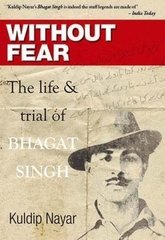
Without Fear


Title: Without Fear – The Life and Trial of Bhagat Singh
Author: Kuldip Nayar
Publisher: HarperCollins, 2007 (First published 2000)
ISBN: 9788172236922
Pages: 244

Like the varied country India is, its freedom struggle consisted of many streams, distinct in form and content from each other. School textbooks and government propaganda on the independence movement harp on a lone strand among them – Gandhi’s nonviolence. This is certainly not astonishing as the Nehru dynasty ruled or influenced the country’s administration for most of the seven decades it was independent. Nehru was Gandhi’s loyal protégé who was hoisted onto the leadership of an unwilling Congress in session at Lahore in 1929 as its president. The very first thing Congress governments did after independence was to sanitize the history of the freedom movement by purging elements hostile to Congress’ ideology and Nehru’s detractors from the chronicles of the country’s fight against the British. Bhagat Singh, whose great self-sacrifice on the altar of the country’s honour is mentioned in a bare paragraph in most of the officially approved accounts. Many books on the martyrdom of Bhagat Singh and his comrades found the light of day only in the last few decades. Singh’s trajectory sparked violence and death. They were not reluctant to kill their enemies and were not afraid to lay down their lives for the cause. Kuldip Nayar is a world-renowned journalist who has made this excellent volume that tells the history of Bhagat Singh’s life and trial.

Nayar portrays Bhagat Singh as a brave and committed nobleman of integrity. Though he was born in a family of zamindars (landlords), he was deeply influenced by the hard toil and pitiable living conditions of his neighbours. His conversion to atheism was deeply rooted, considering the fact that he was just 23 when he died. Singh’s courage is exemplified by an incident on the day he was hanged and narrated touchingly in the book. When his lawyer visited him to ascertain his last wish according to procedure, Singh enquired whether he had brought the book ‘The Revolutionary Lenin’ requested in an earlier meeting. As soon as the book was handed over to him, Singh started reading it with great interest and absorption, even though he was scheduled to be hanged a few hours later. Seeing Bhagat Singh’s portrait with a European hat and clean shaved chin, many people are confused as to his religion. It is incongruous to enquire about the religion of an atheist, but Bhagat Singh was born a Sikh. He had cut off his hair and shaved off the beard as part of the plan of disguise to assassinate the police chief of Lahore.

Though at loggerheads with each other, Bhagat Singh’s Hindustan Socialist Republican Association supported mass actions initiated by Congress. When the Simon Commission was blockaded at Lahore railway station, the police baton-charged the protesters in which the widely respected politician Lala Lajpat Rai was seriously injured when J A Scott, the superintendent of police personally rained blows on his head. He died a few days later which unleashed a huge wave of resentment. Singh and his associates wanted to avenge Rai by killing Scott, but the man tasked with identifying the officer mistook Saunders, his deputy, for him and the assailants killed the wrong man. It was for this murder that Bhagat Singh, Shivram Hari Rajguru and Sukhdev Thapar were handed the capital punishment. Around the same time, the Central Assembly at Delhi was contemplating two draconian regulations. The Public Safety bill was designed to empower the government to detain anyone without trial, while the Trade Disputes bill was meant to deter labour unions from organizing strikes, particularly in Bombay. Bhagat Singh and B K Dutt threw bombs on the assembly floor in protest against the bills, while taking special care not to cause injury to anyone. The assembly claimed many Indian members like Motilal Nehru, Jinnah, N C Kelkar and M R Jayakar among its members. Singh and Dutt were arrested on the spot and later implicated in the Lahore assassination also. Many accomplices turned approvers and the prosecution’s mainstay was the evidence given by them.

Nayar brings out Singh’s outrage at Gandhi’s passive, nonviolent struggle in detail. However, the jailed revolutionaries adopted Mahatma’s tried and tested program of hunger strike to demand improved facilities in the prison such as better food and living conditions, a special ward for political prisoners and parity with European prisoners lodged there. While all of Gandhi’s hunger strikes ended conveniently before it seriously threatened the leader’s health, the revolutionaries were not so lucky. Jatindra Nath Das died of starvation. Singh and others escaped this fate as they bowed to a Congress committee resolution to call off the protest on the 116th day.

A prominent part of the book is dedicated to cover Bhagat Singh’s trial, in which the author unfortunately shakes off his reputation for critical thinking and follows it with as much patriotism as is seen in a young initiate. Nayar accuses the court and its proceedings to be a sham. However, this is to be understood in conjunction with the numerous petty objections raised by the accused that were solely crafted to obstruct and hinder the smooth functioning of the court. Reading out loud a message of felicitation on Lenin Day (21 Jan 1930) in open court was just one of the charades. Many a times they declined the summons and didn’t even come to the court. Rai Sahib Pandit Sri Kishen, a first class magistrate, was assigned to try the case at first. Seeing him ineffectual, the government transferred the proceedings to a tribunal consisting of three high court judges Coldstream, Agha Haidar and J C Hilton without any right to appeal except to the Privy Council. It was also given powers to deal with willful obstruction and to dispense with the presence of the accused. This was necessary as the visitors too often shouted in open court. The police once beat up the accused when they refused to be removed as ordered by Justice Coldstream. The prisoners then declined to attend the proceedings of the court until he was removed. The government complied with this strange demand and Coldstream was asked to go on long leave. J K Tapp was appointed in his place and Justice Haidar was replaced by another Indian judge, Abdul Qadir.

Gandhi and the Congress cold shouldered the demands to save Bhagat Singh and other accused by failing to intervene with the viceroy to commute their death sentence to transportation for life. The viceroy was anxious to ensure Gandhi’s participation in the Second Round Table scheduled later that year in 1931 and the government’s compulsions were amply visible in the concessions it granted as part of the Gandhi-Irwin Pact signed on 5 Mar 1931, just 18 days before Singh was hanged. It was surely in Gandhi’s power to save the lives of the trio, but his half-hearted presentation of their case convinced Lord Irwin where his real sympathies lay. In fact, it was said that Gandhi requested the viceroy to execute the sentence before the planned Congress session in Karachi towards the end of March 1931 in an effort to forestall a possible demand from the delegates to seek commutation of the sentence as a precondition to the pact being ratified. If Singh was already hanged, Gandhi could preempt his detractors with a fait accompli. However, we should not lose sight of the substance behind the Mahatma’s reticence. A daring plan was being hatched by the revolutionaries to rescue Bhagat Singh from jail, but it failed when the bomb went off during a dry run, killing the leader of the assault then and there. The comrades had planted a remote-controlled bomb on the Viceroy’s Special train which again failed to cause him any injury. There was an assassination attempt on Khan Bahadur Abdul Aziz, the superintendent in charge of the investigation. These violent episodes might have forced Gandhi’s hand when he requested the viceroy to commute the sentence only because public opinion ‘rightly or wrongly’ demanded it and internal peace was likely to be promoted by it. It failed to break the ice with the British and the three patriots were hanged on Mar 23, 1931. Nayar reproduces Gandhi’s letter to Irwin.

However wholeheartedly the Indian people support the patriotic fervor of Bhagat Singh, the emphasis on violence against political opponents stirs the imagination of modern-day separatists too. Nayar tells about a letter received from Harjinder Singh and Sukhjinder Singh, who were awaiting their execution for assassinating General A S Vaidya for directing the military operation on Harmandir Sahib codenamed Blue Star. They claimed their operation to be on par with what Bhagat Singh had done against the British. The author clearly demarcates the meaning of the word ‘terrorist’ from ‘revolutionary’ in no uncertain terms. Lines from Urdu couplets and poems are given at the beginning of each chapter. Not providing a translation of these verses excludes a good section of the readers not conversant in that language from appreciating its message. The book casts some doubt on the motives of Sukhdev Thapar who was hanged along with Singh. He is accused of deliberately suggesting Singh’s name in the planning stages with the vile motive to get him killed. A few letters from Hans Raj Vohra, the approver in the case, to Sukhdev’s brother accuses the martyr of revealing crucial information to the police. The book also includes three excellent essays written by Bhagat Singh titled ‘Why I am an Atheist?’, ‘The Philosophy of the Bomb’ as a reply to Gandhi’s advocacy of nonviolence and ‘To the Young Political Workers’. These articles open a window to Singh’s sharp and critical mind.

The book is highly recommended.

Rating: 3 Star

Monday, May 28, 2018

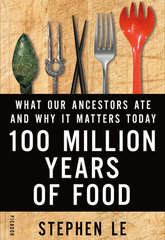
100 Million Years of Food


Title: 100 Million Years of Food – What Our Ancestors Ate and Why It Matters Today
Author: Stephen Le
Publisher: Picador, 2016 (First)
ISBN: 9781250050410
Pages: 309

While it is undeniable that human health is in its most marvelous phase ever in its history, it is really hard to come across a person entirely satisfied about his state of health. Awareness and the tons of information on ailments reaching the common man has helped to ward off diseases, but the apprehensions about newer and stranger diseases keep the society on tenterhooks. As I write these words, the South Indian state of Kerala is in the throes of a battle against a previously unheard of viral disease caused by a kind of deadly pathogen known as the Nipah virus. Sometimes, the food we eat also forms the channel through which harmful bacteria and viruses reach our body. Even if we lay aside the menace of microbes for the time being, it is arguable whether we keep a healthy diet. With the changes in habitat and lifestyles, most people follow a diet that is greatly at odds with that of their ancestors. Also, the cherished notions about food and nutrition often turn out to be wrong when viewed in a broad context. This book is a valiant effort to reach an understanding of what our ancestors – not all of them humans, of course – ate in the last 100 million years of evolutionary history. It explains what we should eat and how we should lead our lives by combining the latest in scientific studies with a dose of evolutionary biology and a review of how people past and present ate and lived. It offers practical suggestions for tweaking the ancestral habits and inserting them into our daily lives to avoid or delay the onset of major chronic diseases. Stephen Le is currently a visiting professor of biology at the University of Ottawa. He received Ph.D in biological anthropology in 2010 and is an ethnic Vietnamese settled in Canada.

The eating habits of our primate ancestors underwent dramatic changes as a result of minor upsets in the genomic roadmap. Around 60 million years ago, our primate forebears lost the ability to synthesize vitamin C due to a genetic mutation in a single gene called GLO. They tided over this handicap by taking to fruits rich in the vitamin and were abundantly available in the surroundings. Similarly, between 40 and 16 million years ago, our ancestors progressively lost the genes for building uricase, the enzyme helping to dispose of uric acid from the body. As a result, uric acid levels in primates rose 3-10 times higher than other mammals, which however helped them to store fat, particularly after eating fruit.

The book repeatedly handles the pros and cons of eating liberal quantities of meat and dairy products. Meat is the greatest source of protein and in the long history of food, our affection for fruit pales in comparison to our affinity for meat. However, choosing an unusually large slice of meat comes with its own problems. Humans can’t consume more than 35-40% of calories in the form of protein due to the accumulation of toxic levels of ammonia and urea as byproducts of digesting and metabolizing protein. Fat and carbohydrates thus provide the bulk of calories needed by us. Stephen Le’s assertion that vegetables are not our original food source may surprise ardent Vegs, but he explains it why. Humans don’t have the specialized digestive systems or teeth that herbivores like guerillas or cows possess to grind and digest large quantities of unprocessed plant foods. The author shocks dairy enthusiasts as well with his prescient remark that compared to milk, alcohol is child’s play. In fact, milk is the most complex substance people consume.

Over the eons, our diet shifted from insects to fruits, meat, agricultural products like wheat, rice, potatoes and corn and then to milk and alcohol. Modern societies consume all these different genera of foods, but we are still unsure about what constitutes an optimal diet. Le asks rhetorically whether a healthy man in a great mood and being fertile and stronger at a younger age is to be emulated than another healthy old man delaying cancer for a couple of years and hanging out with his great-grandchildren. The book contains many good chapters on the tinkering required in diet for a healthy life. Calorie restriction is a good method for longer life, but studies point out that the calorie intake of modern people is much the same as primitive hunter gatherers. But the latter were slim and fit while the former fights a losing battle with obesity. The fraction of obese people as a proportion of the whole goes steadily up in every society. Le surmises that our voluntary inactivity may be the key to our expanding waistlines. Watching TV and indiscriminate usage of automobiles to cover even short distances are killing us slowly. To make his point, Le visits Ikaria in Greece and Okinawa in Japan to showcase the efficacy of long walks which are mandated by the geography of these islands. Anyhow, the traditional diets are fast receding into oblivion in these places too.

The book’s moral is easily evident as it is reiterated many times in the text. To lead a healthy and longer life, we need to practice exercises of moderate physical activity, adhere to traditional cuisines, and eat more animal foods when older. Going after traditional diets forces the author to hunt for restaurants that serve such bizarre fare as insects and crickets in Southeast Asia.

What is disappointing in the book is its painfully evident bias towards unscientific fads of modern society such as organic farming and mindless opposition to genetically modified (GM) foods. Of course, this is not the place for a full discussion of the pros and cons of organic farming and avoidance of chemical pesticides, but it is fairly obvious that the organic movement is not going to be good for the food security of the world in the longer term. Having lower crop yields, organic farming is a wasteful exercise that squanders precious resources such as land, seeds, water, manure and manpower. This is especially significant when the supposed ill-effects of scientific agriculture using chemical fertilizers and judicious use of pesticides are nowhere to be found. Le advocates ban on the use of genetically modified foods till more tests on its long-term safety are conducted. This is a self-defeating argument. How can you test them if you ban it outright and continue to arraign it in the media and every available forum? Europe keeps them at arm’s length while America continues to enjoy its varied flavours. So, a definitive answer to this puzzle might not be long in coming after all, when we learn that 93 per cent of soy, 90 per cent of corn, 95 per cent of sugar beet, 93 per cent of rape seed and 30 per cent of alfalfa crops in US and Canada are already GM. In order not to scare away customers, the manufacturers prefer not to indicate this fact on the product package. The book’s unsubstantiated attack on MSG (monosodium glutamate) is unscientific as the perceived after effects of consuming it is both fanciful and unproven. Le claims that German researchers have found that MSG can cause headaches (!) when ingested in large quantities! Is it such a big deal? Le admits that scientists and mainstream media discuss MSG concerns as uninformed public hysteria.

The first part of the book is very witty when we follow the author travelling to many remote parts of the globe in search of novel foods and read about pleasing adventures. After the first few chapters, the narrative loses focus and degenerates to the level of a dietary and health handbook. This book is not a record of the varied culinary stages through which human societies reached where they are today, but rather on what they should eat for better health. It impels the readers to follow sustainable farming practices that do not snatch food away from the plates of future generations.

The book is recommended.

Rating: 3 Star

Monday, May 21, 2018

The Square and the Tower


Title: The Square and the Tower – Networks, Hierarchies and the Struggle for Global Power
Author: Niall Ferguson
Publisher: Allen Lane, 2017 (First)
ISBN: 9780241298985
Pages: 574

The social structures that we see around us today are the result of incessant interactions between human beings. When people interact with each other, some etiquette is required to be maintained. The inter-personal relationships in an organization can be hard or soft as demanded by the purpose for which the people have joined it. These associations between people can be broadly classified into two – networks and hierarchies. Being a member of a network gives influence to an affiliate while a hierarchy imparts power to its constituents. If you ‘report’ to someone, you are in a hierarchy. From the very beginnings of civilizations, networks and hierarchies exerted their push and pull on the way history flowed. This book tells the story of the interaction between networks and hierarchies from ancient times until the very recent past. Niall Ferguson is a British historian and commentator, and is currently a senior research fellow at Jesus College, Oxford. He is known for his provocative, contrarian views. Many of Ferguson’s books have been reviewed here earlier. In 2004, he was named as one of the 100 most influential people in the world by Time magazine.

Networks and hierarchies enjoyed a commingled role in shaping events that turned the wheels of world history. The recurrent and near universal problem of ancient history was that the citizens of warring states generally ceded excessive powers to hereditary warrior elites whose function it was to inculcate religious doctrines and other legitimizing ideas. At times, the hierarchy was essential to move forward out of a vexing problem or simply to survive. Ferguson credits the invention of the printing press as the most influential single event that altered the course of history. Printing helped to unleash the huge political and religious disruption of the Reformation. Gutenberg’s movable type technology came around 1450 CE. This revolutionized the way information reached people, helping to establish countless networks in every sphere of human activity. Without Gutenberg, Luther might well have become just another heretic whom the Church burned at the stake. With the advent of cheap paper, more of the populace joined intellectual discourses of the era. Cities with at least one printing press in 1500 CE were significantly more likely to adopt Protestantism than cities without printing. This new technology also helped the scientific revolution and Enlightenment. After Luther’s Reformation, Protestant states began to show signs of greater economic dynamism. Re-allocation of resources from ecclesiastical to secular activities loosened the reins held by the clergy. Two-thirds of all monasteries were closed in Protestant territories of Germany. Their land and other assets were appropriated by secular rulers and sold to wealthy subjects. It was how the Reformation, in itself a religious movement, contributed to Europe’s secularization.

Popular fiction is rife with conspiracy theories and secret societies. ‘Illuminati’ is at the centre stage of Dan Brown’s immensely popular thriller ‘Angels and Demons’. We are surprised to learn that a society of that name indeed existed in Europe before the French revolution. Another favourite gang of best sellers are the Freemasons, whose members are said to have been administering all major governments and organizations in the world. Freemasonry furnished the Age of Reason with a powerful mythology, an international organization structure and an elaborate ritual calculated to bind initiates together as metaphorical brothers. Freemasons participated in America’s revolutionary war, but it is not correct to assign it the credit of victory.

A major portion of the book is dedicated to networks and hierarchies that dominated the political arena in the twentieth century such as communism, fascism, Nazism, Islamism and others. The author presents some new ideas on German wartime strategy during World War 1. They fanned Islamic fundamentalism to cause internal strife in British colonies such as India which were at war with Germany. This aspect requires more study for students of the Indian independence movement. Unlike in the Second, Indians wholeheartedly sided with Britain in the First World War without making any preconditions on self-rule. Indian troops served exemplarily in the War. Even then, disturbances were breaking out in many parts of India. The downfall of the Ottoman sultan infuriated radical Muslims who viewed the sultan as the Leader of the Faithful. Incitement from Germans made rebels out of the Muslims and young revolutionaries like the Gadar movement. The spiral of violence gained strength by each passing day and went out of control at JallianwalaBagh. Ferguson sets aside a chapter that narrates the strategic German actions in India and the Middle East to foment jihadism. I haven’t come across any other book that deals with the post-World War 1 insurrections in India and the role Germany played in it.

A shocking revelation given in the book is the support extended by Kaiser's Germany to elevate Lenin as the ruler of Russia by usurping Tsar Nicholas II who was locked in a war with them in World War 1. Lenin was exiled by the Tsarist regime earlier and was residing quietly in Switzerland. Germany transferred 50 million gold marks ($800 million in today's money) to Lenin and his associates - much of it laundered through a Russian import business run by a woman named Evgeniya Sumenson. Kerensky's provisional government in Russia was too lenient and not competent enough to tackle the Red menace. Had he imprisoned Lenin and his comrades the moment they arrived in Russian soil, the famed October Revolution would've been stillborn. Lenin and Stalin didn't repeat Kerensky's mistakes though. The large-scale repressive state organs they instituted spied on the Russian people and punished them harshly for even the smallest misdemeanors. It is estimated that if we include the exiled people into reckoning, the share of the population who experienced some kind of penal servitude under Stalin approached 15 per cent of the total. The Bolshevik Revolution was hence a successful German plot to subvert Russia that came to haunt them and prove to be their nemesis in the Second World War. Such hidden truths are hard to come by in today's society dominated by the so called 'Left-leaning Liberals'.

The book is rather very big, but a sense of pointlessness pervades it all. Of course, man is a social animal and social networks stay solidly behind any collective activity. In that sense, a history or commentary of such associations is by definition a history of mankind itself. The author introduces some new concepts such as betweenness centrality which finds significance in network analysis. He had included numerous network diagrams with multiple nodes, which are mostly unreadable and unappealing. Recent coverage in the book includes growth of the Islamic State in Syria and Iraq which follows a loosely interconnected network strategy rather than the top-down hierarchy of bin Laden's al-Qaeda.

The book is highly recommended.

Rating: 3 Star