Wednesday, January 30, 2013

The Age of Kali


Title: The Age of Kali – Indian Travels and Encounters
Author: William Dalrymple
Publisher: Flamingo, 1999 (First published 1998)
ISBN: 978-0-00-654775-4
Pages: 371

This book, published in 1998 was Dalrymple’s fourth and third in his series on Indian themes. He is a renowned author, requiring no formal introduction to the subcontinental readers. He is staying in Delhi and has become a distinguished presence in Indian literary circles. This is his sixth book to be reviewed in this blog. The earlier ones are, The Last Mughal, White Mughals, Nine Lives, City of Djinns and From the Holy Mountain. With his easy prose verging on the graceful contours of finely crafted verse, each book is a cherishable experience for the reader. Now there are only two Dalrymple books which have not been presented here, In Xanadu and his latest, Return of a King, which are eagerly awaited.

The Age of Kali (not to be pronounced Kaali) is the story of the writer’s travels across the Indian subcontinent. The title implies Kali yug, which is the fourth and last era of Indian time reckoning, in which virtue and the good beats a retreat, paving the way for evil and vice. The traditional society blames every misfortune that has fallen on them to be because of Kali yug and resigns calmly to fate. In the book which is partitioned into six parts, namely The North, In Rajasthan, The New India, The South, On the Indian Ocean and Pakistan, the author travels extensively and records his experiences at each place. Comparisons are inevitable in such a setting and he notes the rising prosperity of the South and the West as compared to Bihar and Uttar Pradesh, which are slowly sinking into a morass of violence bordering on lawlessness and corruption. He also brings into focus the enormity in scale of the annexation of Hyderabad and Goa to India which are euphemistically called ‘police actions’ in official history books. Recording the experiences of eye-witnesses, we get to know that they were full fledged military operations involving the army and air force, and also the navy in Goa.

While being a pleasure to read, on many occasions the author falls in the trap of eulogizing over the lost grandeur of aristocrats fallen from grace as the country gained independence from colonial or local imperialist powers. Traces of this trait was discernible in the author’s earlier book, City of Djinns which based Delhi as its theme in which he blindly followed the riches-to-rags nobility of the old Mughal system. During his travels in Lucknow, narrated in the chapter Kingdom of Avadh, we see a little known feudalist Suleiman gloating over the things he lost in the feudalist period like poetic symposia, architecture (which naturally changed with the times) and even prostitutes who could recite Persian verses. Not a small portion of his grief is over the fact that those dear artifacts of his past no longer exist anywhere. This feeling of nostalgia over the loss of the past is seen to transcend religious barriers. When he visited the Rajmata Vijayaraje Scindia in Gwalior, her own attendants who were Hindus commiserated over the lost kingdom of the Maharajah with its extravagantly gilded processions, tiger hunts and the absence of corruption. We have only their word to attest to the last named item! But even they couldn’t deny the wastefulness of lavishly constructed Jai Vilas Palace nearby in a vain bid to impress the Prince of Wales who paid a visit to the place in the latter half of 19th century. The palace was constructed at a huge expenditure on the impoverished exchequer.

What is quite unexpected and revealing is Dalrymple’s visit to Deorala, Rajasthan where in 1987 a young widow named Roop Kanwar chose to die by burning herself on her husband’s funeral pyre. With about 500 villagers as spectators, the flames consumed her, who was sitting on the pyre with her dead husband’s head on her lap. Makeshift temples were quickly erected for her as she had turned into a goddess, Sati mata, with her valorous deed. Protests soon broke out at many places. Journalists and women activists exposed the incident and claimed that she was forced to die by her relatives who were accused of having drugged her. Police arrested 66 of the villagers and used third-degree measures to elicit a confession from them. The case went on for 10 years until the trial court acquitted all of them for want of evidence with severe criticism reserved for the police for the way they investigated the case. Dalrymple visited the village, interviewed them and later corroborated the story with senior civil servants at the state capital. The facts which come out is indeed shocking. Roop had really chosen to die of her own free will, with no apparent coercion. The modern part of India, the anglicized urban elite couldn’t stomach the idea that connubial fidelity would drive a young woman to court death. Such secular incredulity marks the remove the elite is from the rural heartland.

Dalrymple has correctly identified the source of much rural strife in India as due to caste enmity. In Rajasthan, he describes how hordes of upper caste Rajputs descended on makeshift medical facilities intended to serve the lower castes and smashed them to smithereens, apparently to protest against the Central government’s decision to implement the Mandal Commission’s recommendations which suggested reservation of 27% of government jobs to backward communities. Rajasthan, however displays the diametrically opposite side of the situation in UP and Bihar, where the backward castes have gained much political power, but even there, the private armies of landlords ride roughshod over them. The author’s assertion that the decision to grant reservation has resulted in an awareness of caste at all levels is, however superfluous. Caste awareness for an Indian is like the proverbial sixth sense. This is something which comes by birth and had existed here for millennia.

Needless to say, the writer knows the rhythm of India and is well versed with the vitality that animates the national psyche in its forward thrust through the well-trodden path of spirituality. The mental subservience to spiritual objects like tombs and godmen flourish in the subcontinent. However, he seems to have a soft spot towards the Islamic side of the Indian cultural stream. Whenever he speaks about the other current, the Hindu stream, it is the backwardness and unsophistication that is unconsciously stressed. Dalrymple may be called the historian of the Indian Muslim aristocracy.

Though the author recognises the touchiness of many Indians towards criticism from abroad, it feels that the criticism is really harsher than warranted by the situation. He describes the clash between two student political unions in Lucknow and declares it to have been fought with assault rifles, which is stretching the imagination a lot. Has he confused Lucknow with Peshawar, which also he has visited? Anyway, he claims that the book is a work of love and “its subject is an area of the world I revere like no other, and in which I have chosen to spend most of my time since I was free to make that choice. I was completely overwhelmed: India thrilled, surprised, daunted and excited me” (p.xv). I think we can accept his arguments at face value.

A major source of disinterest seen in the work is the chapter on Reunion Island, which is distracting in a book centred on Indian themes and people. Stories on Pakistan and Sri Lanka illustrate the cultural continuity of the subcontinent across political and religious divides. No such affinity exists with Reunion which is a small French island colony in the Indian Ocean and it sticks out like a sore thumb. Also, clubbing Goa along with chapters on Sri Lanka and Reunion smacks of a feeling that it is not culturally homogeneous with the rest of India.

The book is highly recommended.

Rating: 4 Star

Friday, January 25, 2013

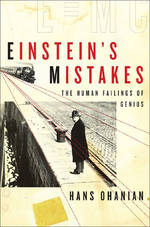
Einstein’s Mistakes


Title: Einstein’s Mistakes – The Human Failings of Genius
Author: Hans C Ohanian
Publisher: W W Norton & Co, 2009 (First)
ISBN: 978-0-393-33768-6
Pages: 338

Albert Einstein is a towering personality in the intellectual landscape of the world of all time. Being a genius won’t ensure a person his place on this coveted setting. Einstein was more than that – he was a physicist of stellar caliber, a philosopher, a humanist, and altogether a great man. At least that was what we had conceived – until we get hold of this book. Ohanian, who is himself a physicist and has written many books on the subject handles the personality and professional career of the great scientist in an incisive fashion. He proceeds by first stripping Einstein of all the sheen generously endowed by an over-eager media constantly on the lookout for a marketable icon and delves into the fallacies and mistakes committed by him – in his theoretical papers and conceptual formulations. Some of his earlier mistakes were mathematical in nature – Einstein was uncomfortable with mathematics. But in an era when physics was reputed to be difficult even for physicists, he couldn’t go on much with his unsure grasp of mathematics. We come across such inadvertent errors in early derivations of relativity theories. Later, he employed mathematical assistants to do the tedious calculations for him. Though the author claims to describe only those errors committed by the genius in his professional capacity, any discussion about Einstein is bound to get tied up in a bit of sensationalism and charisma pervading his person. So we read about his adulterous liaisons and partisan leanings towards the fair sex.

Einstein completed his schooling and graduation in Zurich, Switzerland. After 2 years spent in a futile search for a job, he was accommodated as a third-class clerk in Federal Patent Office in Berne which left him with ample time for his pet theories and research. Though he managed to publish several insignificant papers earlier, the year 1905 turned out to be the year of miracles. He published five original papers in the journal Annalen der Physik, all of which proved to be milestones in the growth saga of physics of all time. His papers included a postulation that light is emitted in discrete packets called quanta (singular, quantum), description of Brownian motion – a random movement of liquid particles due to collisions at the atomic level, special relativity and the energy-mass equivalence – the most famous equation, E = mc2.

Einstein’s relativity principle was first proposed not in so many words by Galileo (1578 – 1642). Elements of references to a relativistic structure can also be seen in Isaac Newton’s magnum opus Principia Mathematica. The real momentum came only in the latter half of 19th century,  when Maxwell discovered the laws of electromagnetism. He observed that his equations yielded a result for the velocity of light which is the same irrespective of the speed of light sources, which was contrary to natural expectation. We observe that if we move in any direction, the object which comes to us with a particular speed will appear to be moving faster than an object receding from us with the same speed. Not so, in the case of light. Lorentz and Poincare developed the idea further, publishing papers on relativity in 1895 and 1904 whereas Einstein published only in 1905. Till the end of World War I, before Einstein’s everlasting fame was not assured with his discovery of general relativity, the principle was known in academic circles as the Lorentz-Einstein Principle. Einstein’s proof of his paper on special relativity (1905) contained several mistakes, some of them related to physical ideas and many of them to mathematical concepts.

Among the stunning revelations made by the author in this book, nothing shocks us more than the assertion that E = mc2 is not an original Einstein contribution! In fact the equation has acquired legendary status owing to associations with him and its contribution to the making of the atomic bomb which devastated Hiroshima and Nagasaki. The author affirms that the equation was known in physics circles several years before Einstein’s attempted proof of it in 1905. J J Thomson, the discoverer of electron had tinkered with it. Einstein’s contribution was the proof of it and in fact it was riddled with mistakes. Max von Laue published the correct proof, followed by Felix Klein. Einstein himself came up with alternate proof over the years, but all contained errors of some kind or the other. That von Laue and Klein didn’t get the credit due to them is one of the injustices of scientific literature. It may also be seen that Einstein had no significant impact on the making of the A-bomb. His letter to Roosevelt urging him to make one citing recent developments in Nazi Germany on the same lines is claimed to have not made much headway in the U.S. Administration. In any case, for nuclear fission, it is possible to calculate the energy released from electric repulsive forces whereas for nuclear fusion, mass-energy relation is the only way. It is curious to note that in Einstein’s autobiography in which he waxes eloquent on his contributions to physics, he is silent on the famous equation. May be he had identified that his grounds for priority is shaky, or else he might have got bored with the long-held association with the equation.

Einstein’s undying fame came with the experimental verification (1919) of the predictions of General Relativity published in 1915. The theory itself was opaque to most people, including prominent physicists and from what is described in the book, it appears that Einstein himself was also unaware of some of the finer nuances. He tinkered freely with the proof of the theorem, and modifying the final statement of it by adding another term called cosmological constant to account for the idea believed to be true at that time that the universe is static. His theory predicted an expanding universe, but to make it static, Einstein added the constant. When Edwin Hubble proved 10 years later that the universe was indeed expanding, a shamefaced Einstein deleted the factor and declared it to be his greatest blunder in life. This fiasco is evident of the fact that the great physicist hadn’t had any clear intuition about what he was driving at. The story didn’t end there. The cosmological constant actually provided for a repellant force at great distances, contrary to gravity which is always attractive. In 2000, observations found that its universe’s acceleration was increasing. This could be accounted for only by adding the factor back into the equation. Physicists term this phenomenon as ‘dark energy’ which is thought to comprise of 71% of all that is in the universe in terms of matter and energy. Fortunately, Einstein was not alive to swallow his words again.

After 1915, when he was 36 years of age, his productivity sagged and no major discovery could be attributed to him. Apart from some occasional sparks of creativity like the Bose-Einstein condensation and Einstein-Podolsky-Rosen Paradox, nothing worthwhile came out. During the last two decades of life, in which he had to flee Germany owing to Hitler’s rise to power, he was absorbed in developing a unified theory of everything, which attempted to integrate electromagnetism and gravity which were the only two fundamental forces known at that time. His papers containing highly abstract mathematical constructs didn’t take him anywhere and as time progressed and Einstein grew old, he was treated as an anachronistic old-timer by his colleagues. He passed away in sleep in 1955 at the age of 76 due to a burst aneurism.

Several glimpses of Einstein’s personal life is also glanced at, in the book. We need not go into the details, except for a brief remark that it was not at all a model for any one. He is portrayed as greedy, having laborious disputes and arguments about his salary. He evaded tax from German authorities by secretly opening an account in Holland and transferring royalties from his publishers to this account. He was a womanizer and having no paternal affection to his own offsprings.

Ohanian’s uncompromising position against superstition and organised religion is commendable. He really loses his temper when narrating the brief biography of Galileo and his ordeals with the Pope and Dominican friars on the issue of whether the sun or the earth moves around on which religion had no locus standi. In confirmity to the iconoclastic treatment of holy or divine authority throughout the text, Ohanian maintains an irreverent attitude to great physicists, like Newton or Einstein. Of course, their contributions are respected and their caliber appreciated, but their weaknesses as human beings is clearly brought out in detail like Newton’s spiteful tricks against competitors and Einstein’s heartless treatment of his first child who was born out of wedlock.

On the down side, the book takes long detours not much relevant to the main topic of discussion like Galileo’s and Newton’s somewhat detailed biographies. Such unnecessary digressions don’t add any specific interest to the argument. On a more serious note, Ohanian’s aversion to use metric units in describing physical phenomena is surprising and abhorrent at the same time. Units of measurement like the mile is expected in an American publication, but unwillingness for using the kilometer is begging contempt from modern readers. Instead of straightaway using kilometer, he employs klicks, which is a term used by U.S. military to denote the same concept. Such American chauvinism is highly deplorable.

Altogether, the book is recommended.

Rating: 3 Star

Sunday, January 13, 2013

Taj Mahal


Title: Taj Mahal – Passion and Genius at the Heart of the Moghul Empire
Author: Diana and Michael Preston
Publisher: Walker & Company, 2008 (First published 2007)
ISBN: 978-0-8027-1673-6
Pages: 284

Taj Mahal is undoubtedly India’s greatest engineering achievement. Built out of an emperor’s sorrow over his dead wife, the white marble mausoleum has been identified as a symbol of India worldwide. The familiar image of the imposing structure on the banks of river Jamuna evokes feelings of awe, wonder, compassion and fulfillment. Influencing the mind of the onlooker is the romantic history of the Moghuls, the only Indian dynasty which could live on in the minds of people of later times through their magnificent buildings and equally magnificent court customs which coloured the imaginations of thousands of poets and story tellers. Most of them were egotistic, megalomaniac and blood-thirsty, resorting to the cruelest methods imaginable to man and which were lavishly employed against their rivals, be them their own brothers, cousins, father or sons. Since the principle of primogeniture was not practiced, the issue of succession in the event of the death of a king always resulted in fratricidal warfare. Unsuccessful princes usually found their eyes gouged out, or if the victor was merciful, they were summarily executed, without adding years of suffering to their lot. Rare exceptions notwithstanding, all of them were pleasure-seekers and ruled roughshod over their hapless subjects. Religious bigotry was practiced during the beginning and end of its flowering period in heartless detail. Thousands of temples were destroyed, thousands and thousands of men and women were taken as slaves or concubines of the rulers and two Sikh gurus were executed. It is clear that the nation does not owe them any moral or social debt for any lasting contribution they had imparted to its society. However, the dynasty still commands attention from us with their tales of intrigue, love and plain cheating.

Diana Preston and her husband, Michael Preston has produced many works under their joint pen name of Alex Rutherford whose book Empire of the Moghul - Raiders from the North has been reviewed earlierin this blog. That was fiction and this one is heavily tinged with details of suspiciously fictional origin. The book begins with Babur’s campaign to India starting from 1526 and nominally covers the end of the dynasty with Bahadur Shah II’s exile to Burma after his fiasco in the first War of Independence in 1857. The heart of the narrative covers Shah Jahan and his rule. Architectural and structural details of the Taj are given in sufficient detail which can be expected from a book targeting general audience. It also describes the changes in appearance affected on the ageless mausoleum after Moghul power waned and authority changed hands, first to British and then to indigenous. The authors have traveled widely in India, Uzbekistan and Iran to visit other construction of similar nature and to compare them to the Taj.

Babur established Mughal rule in India after defeating Ibrahim Lodi at the first battle of Panipat in 1526. That empire was not secure as Babur’s Turkish court couldn’t obtain cooperation from the Afghan nobles who made up the Delhi Sultanates. His son, Humayun was defeated by Sher Shah and thrown into exile. However, he regained his kingdom which grew to gigantic proportions under his son Akbar’s reign which nearly lasted a half-century. Akbar’s eclectic ideals on religion and government helped the various parts of the country to come together in a cohesive way. The sun of Moghul paramountcy rose in Akbar’s reign and probably set at around the completion of Taj Mahal when the empire began reeling under financial stress, caused in no small measure by the great building projects of Shah Jahan. Akbar was followed by his son Jahangir, to whom Shah Jahan was born.

Though Shah Jahan was the favourite son of his father, their relations soured towards the end of Jahangir’s father. In the power struggle which ensued the invalidation of Jahangir, who was addicted to opium and liquor, Shah Jahan killed his brothers Khusrau, Shahriyar and Dawar Baksh, and his two nephews (the sons of Prince Daniyal, his long dead brother). Unlike other Mughals, Shah Jahan was really attached to his wife Arjumand Bano Begum, who was later known as Mumtaz Mahal (the chosen one of the palace) who accompanied her husband in his times of travails – during battles and when he was hounded by an angry Jahangir’s troops for insubordination. In their marital life which lasted 19 years, Mumtaz bore him 14 children, of which 7 died and she herself died in labour during the 14th. The relentless pregnancies must have cost severe stress on the queen’s health which was accentuated by travel through hostile terrain. Mumtaz breathed her last in Burhanpur in Central India in 1630 where they were camped while proceeding for battle with Deccan Sultans in the far south of the country. She was interred in a nearby garden. After Shah Jahan returned to Agra, his capital, he started construction of a mausoleum in deference to the dying queen’s wish. It took 16 years to complete the grand structure which has remained an object symbolizing conjugal love and dedication.

The marble for the structure was brought from Makrana in nearby Rajastan, and the design shows a seamless mix of Hindu and Islamic architectural styles. Built by Indian craftsmen, who skill was appreciated even by Babur, who had found India a dull place in every respect, the monument soon rose to the sky as a mark of human achievement in the unblemished grandeur of the building. Time went on, along with Shah Jahan’s troubles with his own sons, finally resulting in his reaping what he has sowed. His own sons fought among themselves at the first sign of weakness of their father. Aurangzeb ascended the throne after a bloody battle of succession in which he killed three of his brothers, Dara Shukoh, Shah Shuja and Murad Baksh in an inhuman way and eliminating his nephews. Aurangzeb’s intolerant practice of following hard-line Sunni Islam alienated fellow kings who were still ruling over a population predominantly Hindu. Local rulers like the Marathas gained prominence during Aurangzeb’s reign and when he died in 1707, the end of Mughal dynasty was a foregone conclusion.

The book is excellently written with handsome helpings from fiction and hearsay. Though it can’t be relied upon for accurate historical details, the book provides a convenient palette of semi-fictional facts over which historical fact may be superimposed. The authors had done a commendable job in making it a real blend of those two. Handsomely helped with illustrations and photographs of various architectural styles and characters, the work offers a complete panoply of tools for the serious as well leisurely-minded readers. More important of all, it arises an urge to visit the Taj among the readers with its neat description of the events which led to its construction, succinct narrative of the architectural niceties and the comprehensive coverage of his latter history. A good index helps to locate interesting details in a flash. It also provides some lesser known details of the Moghul monarchs such as,

a)      Akbar had more than 300 wives, many from Rajput dynasties, though he gave none of his daughters in marriage to other rulers
b)      Akbar ended the bizarre right of Muslim magistrates to spit in the mouth of Hindus who were late in paying Jizya, the religious poll tax which non-Muslims had to pay. (p.32)
c)      Jahangir possessed 125 kilos of diamonds, pearls, rubies and emeralds alone – amounting to 625,000 karats of gems
d)      Agra in 17th century had a population of 750,000 which was more than double that of London at that time (300,000).

Though not exactly very relevant to the subject matter of the book, it also describes a lesser known fact about Babur, the founder of the dynasty. He was a bi-sexual with his homosexual tendencies evident from his diary (Baburnama) in which he writes about a servant boy who was later came to called Baburi (meaning Babur’s). Babur writes, “I developed a strange inclination for him – rather I made myself miserable over him. Before this experience I had never felt a desire for anyone. Occasionally Baburi came to me but I was so bashful that I could not look him in the face, much less converse freely with him. There was no possibility of speaking coherently” (p.13).

The book is highly recommended.

Rating: 3 Star

Monday, January 7, 2013

The Real Thing


Title: The Real Thing – Truth and Power at the Coca-Cola Company
Author: Constance L Hays
Publisher: Random House, 2005 (First)
ISBN: 978-0-8129-7364-8
Pages: 358

Nothing is more familiar to the world’s younger generation than the fizzy, brown liquid touted as the ubiquitous symbol of energy and vitality – Coca-Cola. Founded in 1886, the company has served many generations of people and has become a legend in business administration. Constance L Hays describes the growth of the company over the years, with special reference to the period after 1980 when changes of a heretofore unseen nature happened and it witnessed its biggest growth dynamics. The book narrates in detail how Roberto Goizueta transformed the company when its sales had plateaued, how Donald Keough and Douglas Ivester steered it through uncharted waters and provided astronomical value for the shareholders. The work ends on a sober note after the grave setbacks faced by the company after 1999 and the silverlining has still not appeared when the book closes at the end of 2004.

Asa Candler purchased the secret formula of Coke from its inventor John Pemberton in 1888. At first, the syrup was mixed with soda water at the point of sale and drank by customers on the spot. Benjamin Franklin Thomas and Joseph Brown Whitehead hit upon the idea of bottling the carbonated syrup so that the product could reach the doorsteps of a larger clientele. At first the company was restricted in its operation to the sale of concentrate to independent bottlers who had the sole responsibility to package and market it. Subcontracting to numerous associates, the bottling industry’s growth was exponential. In 1919, the bottle’s dimensions and look were standardized. The clout of the bottlers was felt too heavy by Coke management soon after. Stuck with a system in which the parent company couldn’t rise the price of syrup, confrontations and legal battles were imperative. However, by the 1980s, more and more bottlers wound up their facilities which were bought or taken over by Coke and its associate, the Coca-Cola Enterprises which was formed to handle bottling business. Though it was technically another company, entrusted with bottling and sales, Coke exerted critical influence in its day-to-day operations as the major stake holder.

The recipe of Coca-Cola is a jealously guarded secret even now. Only a few people even inside the company know the ingredients, a list of which is kept in a bank locker. Analysts have however identified the components from its chemical signatures. When it began in 1886, Pemberton used trace amounts of Coca leaves (from which cocaine is extracted), the flavour of cola nut from Africa, lime juice, vanilla and several other substances in the make up. Cocaine was not regarded as a harmful narcotic at that time, with physicians freely prescribing it for aches and relief. Coke was quick to withdraw the coca content when it was legally untenable to go along with the existing practice. The formula was again changed drastically in 1985 to address the rising market share of Pepsi, Coke’s biggest rival. The initiative was a very bold one to face Pepsi’s challenge which offered a better taste. However, the move backfired when it was rejected outright by the customers. New Coke, as it was known as a replacement of the old one flopped in the market and the company was forced to bring back the old recipe after just 78 days.

Coke always strived to be one step ahead of its rivals, often resorting to dubious marketing strategies. It sought to obtain monopoly rights to get its products displayed in supermarkets and convenience stores. Coke’s tactics of strangling the competitors often went afoul of anti-trust legislations and judgments were issued against the company. In 1996, in a major coup, it stole Pepsi’s bottler in Venezuela to solely do the bottling for them. The latter half of 1990s was however destined to witness the sagging growth of Coke. First the company was sued against by some of its own black employees alleging racial discrimination. It became apparent that the number of blacks in senior management positions was abysmally low when they constituted 15% of the overall workforce. Compounded with it was the recall of product from Belgium, France and some other European countries when it was detected that the carbon dioxide gas used in the bottles was contaminated. It eroded a huge chunk of credibility from the company. In 2000, Coke was forced to fire about 20% of the labour in a vain attempt to cut costs. When the narrative ends in 2004, we get the impression that not all is well at Coke.

The book is a disappointing one. It recounts the history of Coca-Cola mainly from 1980 onwards. Lacking an effective organising structure, the narrative which lacks any interesting feature shuttles back and forth between decades and centuries landing the readers in sheer confusion. Except for occasional flashes of witty comments, the description is drab. The layout is very bad, printed in very small letters and an unappealing font. Altogether, the book is a very unremarkable one.

The book is not recommended for the general reader.

Rating: 2 Star

Tuesday, January 1, 2013

No Easy Day


Title: No Easy Day – The Only First-hand Account of the Navy SEAL Mission that Killed Osama Bin Laden
Author: Mark Owen with Kevin Maurer
Publisher: Michael Joseph, 2012 (First)
ISBN: 978-0-718-17752-2
Pages: 299

The twin attacks on World Trade Center in New York was one of the moments people anywhere in the world is not going to forget for a long time to come. Whether you were a resident of Japan, India, Egypt or Brazil, you’d still be remembering the exact place and setting you were in, when the news broke on TV. It too days for the world to finally sink in the truth that Osama Bin Laden, as Islamic terrorist holed up in Afghanistan could carry out an attack on such a humongous scale against the most powerful nation on earth. A massive manhunt ensued the likes of which were not witnessed before. Years passed and most of the world mocked at the Americans for their failure to apprehend their greatest fugitive and came to the conclusion that he’ll never be caught. But the people who made it their mission to track Osama continued their silent work until they stood vindicated on the early morning of May 2, 2011 when Laden was killed in a Navy SEAL operation at his compound in Abbottabad, Pakistan. His dead body was carried off by the assaulters and given a silent, but religious burial at sea.

This is the story of that operation. The author, Mark Owen is a nom de guerre of the commando who participated in the mission and a team leader of one of the groups which went inside Laden’s compound, overpowering the inhabitants. He saw Bin Laden’s body, took photographs of it and cleared the rooms. For security reasons, his as well as his team mates’ names are changed. The real author, Kevin Maurer, is a writer who has covered special operations forces for many years. He was often embedded with troops in many parts of the world.

Navy SEAL is the U.S. Navy’s Sea, Air, Land team, which is a special operations force. Equipped with the most modern and lethal weapons and surveillance technology, a SEAL is more than a man in terms of the fire power at his disposal. He can see at night – with night vision goggles, his guns are sleek, silent, accurate and fast, his vest is light and bullet-proof, his radio communicates with his team members on the ground and with the command centre through a satellite link. Equally or more dangerous is the mission for which he is called for. He enters the hideouts of militants - most of them bent upon doing a suicide mission – and destroys the targets. Owen describes the gruelling training regime which a SEAL has to undergo to be a part of the elite force. Whenever they are not on actual duty, they’d be training somewhere else, simulating extreme conditions of atmosphere where they might be called upon to operate one day. Owen himself was deployed in Iraq, Afghanistan and Somalia before he was assigned to the team targeting Osama Bin Laden.

Osama was the son of a Saudi billionaire. Born as the seventh child on the tenth wife of a father who’d go on to have a total of fifty children. Attracted to religious orthodoxy from a very early age, Laden moved to Afghanistan to fight the Russian occupation, sometimes aided by U.S. weapons. After the Soviets withdrew, the restless Laden turned against his own allies and orchestrated the bombings against U.S. embassies in Kenya and Tanzania. Exiled to Sudan as a result of American pressure on the Saudis, he founded Al Qaeda. The new organisation planned and executed a number of attacks on American targets, the assault on U.S.S. Cole in Yemen being one of them. Laden found asylum back in Afghanistan under the Taliban who wholeheartedly welcomed their one-time colleague. Bin Laden attained ever lasting notoriety by masterminding the attacks on World Trade Center in New York and Pentagon in Washington. A total of 3000 people of many nationalities perished in the attacks which shook the whole world to its core. It had never witnessed such a horrendous strike before, of crashing in hijacked aircraft on to targets. U.S. stung into action immediately and toppled the Taliban regime a few months later. Laden was on the run from 2001 onwards and a relentless manhunt went on in search of him until the CIA zeroed in on him to Abbottabad in Pakistan.

The CIA had many false starts in tracing the master terrorist. He was reportedly sighted at various places, facilitating a large scale operation in Tora Bora caves in 2007. The real turning point came when they identified the brother of Ahmed al-Kuwaiti who was Laden’s courier. Cut off from the outside world in his compound which didn’t have telephone or Internet connections, al-Kuwaiti was his right-hand man. The CIA traced his phone call to his family when he said that he had been doing the job he did earlier, confirming the sleuths’ suspicions. The suspected compound was continually watched by drones, satellites and other means. The layout of the area was utterly familiarized by the SEALS by re-creating the structure in the attack team’s training facility before they went in for the kill. The curious thing we note in the book is the lack of preparation on Bin Laden’s part to fight the commandos. Even though he had fifteen minutes in which to prepare a weapon or suicide vest, Laden was unarmed when the assualters rushed in. Owen remarks that the man who advocated thousands to court death in Jihad (the sacred religious wars) was unwilling to risk his own life when the time came.

Though the description of previous missions is flamboyant which is to be expected from a soldier, he could’ve done away with descriptions that reeked of disrespect to their victims or targets. Commandos who take bras from households they raided, only to hang it on to projecting attachments on their team mates’ gear appear revulsive to the readers, however hilarious it might have seemed to the proponents. Also the description of taking out Laden’s body from the truck to the ground after they reached their base in Jalalabad is in bad taste. Owen states that his body ‘flopped like dead fish to the ground’ (p.265). The book is mainly an item of propaganda, even with all protestations of the difficulties in getting it whetted by the security system. It conveys the idea of invincibility of the special forces.

The book is easily readable and is endowed with good colour plates on the training missions in Afghanistan and other parts of the world. Also, detailed schematics of Laden’s compound and the methods of commandos to get inside provide amply for leisurely reading.

The book is recommended.

Rating: 3 Star

Friday, December 28, 2012

Songs of Blood and Sword


Title: Songs of Blood and Sword – A Daughter’s Memoir
Author: Fatima Bhutto
Publisher: Penguin/Viking, 2010 (First)
ISBN: 978-0-670-08280-3
Pages: 438

The author, Fatima Bhutto is the daughter of Murtaza Bhutto, the son of Zulfikar Ali Bhutto, who was the prime minister of Pakistan during 1970s. The book covers a daughter’s fond memories of her father who rebelled against a military junta who killed her grand father and had to go in exile to escape punishment. Murtaza fought elections while still in exile and won but was killed in a police encounter purportedly orchestrated by his brother-in-law, Asif Ali Zardari, the current President of the strife-ravaged country. Fatima witnessed the growth of her father in the political arena and had the misfortune to be an eyewitness to his untimely death.

The Bhutto family is one of Asia’s most prominent political dynasties in terms of the power they wielded over the lives of millions of fellow country men. They were feudal landholders with ancestry traceable back to Rajput warriors who emigrated from Rajastan. As is the wont of feudal lords everywhere, they maintained their domain on the good books of powers that be. Shahnawaz Bhutto was knighted by the British, while his son, Zulfikar Ali Bhutto first appeared on the national scene with a birth in the military dictator Ayub Khan’s cabinet. With power comes risk and many Bhuttos died a violent death. Zulfikar was hanged by opponents in 1979, Benazir assassinated in 2007, Murtaza killed in 1996 and the author’s uncle, Shahnawaz was found dead in mysterious circumstances in 1985. Tallying the family’s political gains against their emotional and financial losses through Zulfikar’s land reforms which made them lose property and murders which eliminated family members, we doubt whether the risk was worth the reputation power brought with it.

Zulfikar was the most pragmatic and the first well-educated member of the family. Though the author paints her grand father’s democratic ideals in glowing terms, his joining General Ayub’s cabinet belies the argument. When Bhutto became foreign minister, he paved the way for Pakistan to become bosom friends with China, cashing in on China’s ill will with India in the aftermath of its war in 1962. He was indirectly responsible for Pakistan’s wars with India. When Mujib-ur Rahman’s Awami League won the elections in 1970, Zulfikar refused to share power with him and Mujib was thrown into prison by General Yahya Khan who was the President. A civil war erupted between East and West Pakistan in which the Pak Army unleashed most heinous forms of terror against its own fellow citizens in the East of the country. Rape was institutionalized as a tactical weapon to stigmatize the Bengalis. As the author remarks, Bangladeshi women were taken as sex slaves by Pak Army regiments. When the refugee influx grew to become a serious concern, India intervened militarily and defeated the Pak troops stationed in present-day Bangladesh. Pakistan was split into two and this was a sleight Zulfikar could never forget, who vowed to fight ‘a hundred years with India’.

When he became the prime minister, Zulfikar alienated people close to him with high-handed measures. He was deposed in 1977 by Gen. Zia ul Haq, whom he had elevated to the top army post overlooking the seniority of five officers. Zia plotted against him, incarcerated him and finally hanged him in 1979 after a hastily conducted mockery of a trial. Murtaza, who was studying in London pledged armed struggle against the regime and chose Kabul in neighbouring Afghanistan as his base, where the author was born. Afghanistan’s occupation by the Soviets complicated matters. Murtaza and his associates found restrictions on their freedom for maneuvering. They were alleged to be involved in terrorist activities including the hijacking of a civilian airliner. He and his brother relocated to Damascus who was soon found dead in mysterious circumstances while on vacation in the south of France.

Meanwhile, things were changing in Pakistan. Gen. Zia was bent on converting the largely secular state into a fiercely guarded theocracy. Clerics were given undue power with authority to overturn the decisions of constitutional bodies. Sharia law was imposed and freedom of women severely curtailed. A set of archaic rules were enacted as Hudood ordinance which even prescribed punishment to rape victims too on the grounds that they had participated in a forbidden sexual act. Zia assisted the hardcore Islamic militia under Taliban to fight against Russian occupation. Harsh censoring was imposed on the press and rebels were summarily imprisoned to serve long terms. All political activity in Pakistan ground to a halt until Zia was killed in a plane crash in 1988. Democracy made a hesitant comeback and Benazir was elected prime minister – a term which lasted hardly two years before being dismissed on the allegations of widespread corruption. Asif Ali Zardari, her husband, had earned the nickname of Mr. Ten Per cent, an allusion to his rate of commission in government contracts.

When elections were declared in 1993, Murtaza contested to Sindh provincial assembly and won from exile. He returned to Pakistan in 1994 on a wave of jubilation, but was summarily packed off to jail from the airport itself on account of terrorism charges levelled against him during Zia’s regime. He was soon granted bail and formed his own party, the Pakistan People’s Party (Shahid Bhutto) as a pawn against his sister’s PPP. Murtaza riled against Benazir, who was the prime minister when Karachi was embroiled in a bloody ethnic strife between the native Sindhis and Muhajirs, who had immigrated from India during partition. Corruption, which skyrocketed and became a national issue was also a point of contention between the siblings. Two years later, he was killed in an alleged fake police encounter orchestrated by Asif Zardari, his brother-in-law. Though the family proceeded legally against him, their argument was thrown out by the courts later.

Even though the book cannot be credited with any extraordinary level of brilliance, we see in it the very high level of emotional bonding between a daughter and her father. Born and living in exile, young Bhutto adored her parents who were soon to be separated, casting her into the custody of her father. She was lucky to have a sympathetic and loving stepmother, but it is only natural that she had an inseparable affinity to her father. The hardships she had had to face while still quite young might appear to be devastating to any lesser mortals, but coming from a high profile family which controlled the stakes in national politics, Fatima Bhutto is well poised to take all miseries in her stride and continue her journey with grace. The book provides a good picture of Pakistani society from 1975 onwards when the country slowly began the slide downhill to the chasm of religious rule.

On the downside, it must be remarked that the author has pursued her preordained agenda irrespective of inputs from her interviewees. Many times, we get the impression that her subjects echo what she herself wanted to say. Through a psychological process, Fatima appears to put words in her subjects’ mouths, or less charitably, it might be a case of outright falsification of facts. The book is also riddled with sharp and irrational criticism against her aunt, Benazir. Even cases of childhood ruckus are projected out of all proportion so as to look like a grave injustice has been done. Selective reading from Benazir’s diaries make her emerge as a mentally unbalanced person. The author’s indirect accusation that she was behind Murtaza’s brother’s death, which was pronounced to be a suicide, also doesn’t look credible. The most severe shortcoming of the book may be argued to be her supporting the terrorist elements – in an indirect way – holed up in the country’s lawless North-Western province. She criticizes the national government and the U.S., which regularly conduct unmanned drone attacks against suspected militant hideouts. Though the attacks are performed inside Pakistani territory without the knowledge of its government, there is no denying that elimination of hardline elements is beneficial to Pakistan as a whole.

The book contains a lot of typographical errors, unexpected from a Penguin-group publication. Historical inaccuracies may also be traced, as in a suggestion that Khilafat movement took place around the second World War (p.187). Fatima’s sense of proportion is again called into question by a grossly overemphasizing adjective she uses for a crowd which assembled to hear her father speak. She says, “a huge crowd of about 2000 people had gathered for the Surjani town meeting” (p.29) – remember, this is in the suburbs of a city of 18 million people!

The book is recommended.

Rating: 3 Star

Saturday, December 22, 2012

From the Holy Mountain


Title: From the Holy Mountain – A Journey in the Shadow of Byzantium
Author: William Dalrymple
Publisher: Flamingo, 1998 (First published 1997)
ISBN: 978-0-00-654774-7
Pages: 463

Ever the incessant travel writer and story teller familiar to us as one who stays here in India, taking in its eccentricities, beliefs and mannerisms, William Dalrymple needs no introduction. With his chaste diction in which he radically differs from Justin Marozzi, another equally great writer and the superb narrative escalate him to one of the great writers of the genre. He is one of my favourite authors, with his titles The Last Mughal, White Mughals, Nine Lives and City of Djinns reviewed earlier in this blog. Once you start reading one of his works, you just can’t put him down until it is finished – as simple as that! In this book, Dalrymple travels around the Mediterranean littoral, retracing the foot steps of an ancient monk through Greece, Turkey, Syria, Lebanon, Israel and Egypt over a period of five months in 1994. The itinerary is comparable to Justin Marozzi’s, as detailed in his book The Man Who Invented History, (reviewed earlier) journeying on the route taken by Herodotus, the father of history to Greece, Turkey, Iraq and Egypt. With these two books side by side, you get a good glimpse of how life goes on in the present Middle East.

Traveling on the path of ancient travel writers is an exhilarating experience as you get the lucky chance to tread the paths, stay in the same cities and take in all scenes that came along the way, exactly like your forebear did in his less technically advanced modes of travel. The author follows John Moschos, an ancient Christian monk in Galilee who wrote The Spiritual Meadow, cataloging his travel and religious experiences gathered during his travel with a fellow monk Sophronius, who later went on to become the Patriarch of Jerusalem. The conditions which obtained in the Middle East in 578 CE when he began his travel which ended in early 7th century was radically different from that which exist today. The region was overwhelmingly Christian, bickering among themselves for minute ecclesiastical details along the lines of Greek Orthodox,  Syrian Orthodox, Monophysite, Nestorian, Armenian and a lot of minor fringe groups. The kings and commoners were oblivious to the dark clouds forming over the Arabian desert in the form of Islam. Hardly a century later, the Christian kingdoms were swept off the face of the earth in the torrent that was to unleash from the followers of the Prophet. The Byzantine emperor clung on to a titular throne until 1453 when the city of Constantinople itself fell to the Ottoman Muslims.

In stark contrast to the conditions prevailed when Moschos made his journey in late 6th century, when Christianity dominated the region, the author finds it overwhelmingly Muslim and the number of Christians dwindling year by year by means of emigration, deportation and alienation by the Muslim regimes. This is nowhere more apparent than Turkey where Christians and their religious institutions are systematically erased off the landscape. The Turks might have some justification for dispelling the Greek Christians, citing a narrow interpretation of nationalism. Turkey and Greece continue to foster enmity going back to several centuries. In response to Turkish actions, Greeks had razed mosques in Athens and other places. But no such excuse hold water for the Turks’ ghastly treatment of its Armenian Christian minority. Dalrymple saw with his own eyes the conversion of an ancient Armenian church to a mosque – in the year 1994! And you thought Turkey was aspiring to join the European Union! Though vying for a place in the European community, archeological values don’t find merit in Turkish eyes if it is on the wrong side of the religious divide. Even now, the oppression Syrian Christians feel is immense. The author himself was stopped and harassed by Turkish police many times, the army even arresting him. On one occasion, we see the security personnel behaving like hooligans at a monastery, just because they provided accommodation to the author.

But Syria offered a picture diametrically opposite to the situation in Turkey. Christians enjoy equal rights and it fact occupy some of the very top posts in the military. Freedom of religion is guaranteed and at many places, both Muslims and Christians pray together. Dalrymple however sounds a warning this oasis in the desert of Islamic fanaticism may not outlast the reign of Asad family who holds Syria in a Soviet-style dictatorship of its Baath party. Himself belonging to a fringe Muslim sect, the Asads encouraged the minorities who are now fearing a backlash when the Islamic fundamentalists oust Asad. The battle is raging on now in Syria, at this writing. Astonishingly, when the author travels to Lebanon, the situation is completely turned on its head. We learn about the atrocities perpetrated by Christian extremists when they had absolute power in the 1970s and 80s. The gruesome violence and massacre executed in the name of religion don’t look different if the culprits are Muslims or Christians. The Maronite Christians had gone on the rampage when it remotely looked like they’d be able to claim the whole of Lebanon for themselves. They exhibited arrogantly superior attitude against their brethren of different faiths, speaking only in French and shunning Arabic, which is the lingua franca of the region. The rise of Hezbollah put paid to the hopes of Maronites.

A short visit to Israel clearly illustrate the moral lessons we saw earlier in Turkey and Lebanon – that the majority religion persecutes the minor ones. Jews, discriminated against everywhere settles the scores on the hapless Muslims and Christians still staying in the holy land. Dalrymple narrates merciless tales of forcible evictions and takeovers the regime regularly unleash on the minorities to make way for townships and kibbutz to house the settlers immigrating from various parts of the world. We may deduce from the scale of highhandedness and resistance to it that peace in Israel is still a long way away. In the last leg of the journey, we move on Egypt – Alexandria and Kharga oasis, to be precise. There too, the ethnic Coptic Christians are beginning to feel the heat of Islamic fundamentalism. Their plight was sinking more and more into despair when Dalrymple visited there in 1994 when Hosni Mubarak still presided over a secular administration. The rampant Islamicization was choking the life out of innocent Copts. Though a secular regime ruled over the land, religious affairs were still administered by the draconian Hamayonic laws which stipulated that Christians need permission from the President of the country himself, to build new churches or repair old ones. Technically, they have to seek permission even to patch up a dysfunctional lavatory in the monastery while mosques were mushrooming all over the country without any legal hassle to slow down the growth rate.

In the characteristic Dalrymple style, the author sketches a faithful and vibrant picture of how life is being lived out by the minorities in the Middle East. We can’t accuse him of siding with the Christians or looking only through the eyes of priests even though he was retracing the footsteps of a monk and accepting the hospitality of the same monasteries depicted in The Spiritual Meadow. Whether in Turkey, Lebanon, Israel or Egypt, the author’s sympathies lay with the oppressed. The narrative goads us to realize the dangerous and fatal prominence enjoyed by religion in shaping the outlook of whole societies. Whatever be the religion, the dominating one in a country persecutes the others and make life difficult for its practitioners. The minorities in India may also take a potent lesson from the harsh realities their coreligionists undergo in the Middle East and compare their paradise-like life in this country under a very liberal religious tolerance extended to them. The book also describes in a nutshell the origins of Christian iconography from Egyptian religions. The images we see portrayed, like St.George slaying the dragon, Christ child in the virgin’s bosom are too often adaptations of similar pictorial myths from ancient Egypt and nothing whatsoever to do with the tenets of Christianity.

The book contain a good number of monochrome and colour plates portraying the places of interest. It also graced by a comprehensive glossary and an index. The only thing we can arraign against the work is the sometimes uncanny interest shown by the author in eliciting an accusation from a victim against the oppressors. It is definitely the natural course for the truth to come out, but the interviewees are often terrified of the consequences when the material is published and they themselves are destined to face the music. Sometimes, the author is simply asked to leave them in peace in a rough way. Still, clinging on to the journalistic passion hidden beneath the layer of travel writing, Dalrymple follows up each lead turning up to its logical conclusion. Sometimes he travels to dangerous localities, just to obtain the testimony of a harassed person so that the world can see and judge for themselves the scale of tyranny heaped on the less fortunate ones.

The book is highly recommended.

Rating: 4 Star