Thursday, February 28, 2013

Travels With Herodotus


Title: Travels With Herodotus
Author: Ryszard Kapuscinski
Publisher: Penguin, 2008 (First published 2004)
ISBN: 978-0-141-02114-0
Pages: 275

This is a delightful little book by Ryszard Kapuscinski, a Polish journalist who died in 2007, yet impresses us a lot with his lucid prose which has no pretensions to pedantry. It was originally published in Polish and was translated into English by Klara Glowczewska, but retains the charm the original had had. Usually, when we approach a translated work, we perceive the lack of spirit which animated the original, but this book is clearly an exception. Kapuscinski’s wit, clarity of thought and economy of words has been faithfully rendered through the perfect transparency of the translator’s work. The author came to know of Herodotus while in Poland after Stalin’s death when state censoring of publications became relaxed for the first time. He was immediately captivated by the book which became his constant companion in his own travels. Like the ancient Greek man who is considered the father of history, Kapuscinski had in him a mind which yearned to cross borders, both geographic and temporal and travel around the world and back into time. Journalism turned out to be his key to unlock the iron curtain which screened Poland off from the rest of the world. He traveled widely, but recollects fondly his travels to India, which was his first foreign trip, to China and to various states in Africa. Herodotus always accompanied him in book form which devoured the author’s attention quite overwhelmingly.

Herodotus was born in Halicarnassus, called Bodrum in modern-day Turkey on the eastern coast of the Mediterranean in 485 BCE. He often got tired of the vain pride Greeks maintained about their homeland and started to collect tales and narratives of historic events from around the known world. His book, Histories, is the first one ever to come out of the genre which described in colourful detail the story of mighty, ancient Persian empire under imposing monarchs like Cyrus, Darius and Xerxes and its war against Greece which ended in an ignominious defeat for the mighty empire. Historians assert this victory as the first in a series of encounters the West had with the East. Indeed, this moment is sometimes regarded as the defining moment which oversaw the birth of modern West, a precinct where democracy and freedom was practiced, pitted against monarchy and despotism of Asia. Herodotus, himself a Greek, however doesn’t fall prey to unduly singing the glories of his compatriots. In a tone which will be wholeheartedly approved even by modern standards of literary judgment, he checked each fact on the balance of critical examination and accepted it as fact only when he was thoroughly convinced of the truth of the matter. However, this does not absolve him of all fabrications. We know that there are lots of fantasies and imagination presented as fact. Herodotus claims that there was a tribe in India which was so black in skin colour that even their semen was black! On such points, we should forgive the story teller in him who had the onerous task of keeping the attention of his listeners unflagged through the better part of an evening.

What Kapuscinski does best is to read human emotions through the intricate web of fact and fiction. While telling us about the deeds, most of them wicked, brutal or amorous, he commands us to think about the emotions which might have fleeted past the minds of the victims or spectators. Standing on the edge of a chasm of time separating us from the characters in the story, we appreciate the similitude which is an inalienable trait of human nature. This thinking from the people’s side is an attractive feature of the author’s style which might have been moulded into shape by an education system overseen by the Communist party, who always respected the equality of men in principle.

Reading about the author’s first trip to India in the middle of 1950s, his remarks go deep into the psyche of our country. Commenting on the widespread poverty which marked urban life, he describes an incident in Calcutta where he saw an old woman preparing a bowl of rice for cooking in Sealdah railway station. She was surrounded by hungry and emaciated children eagerly watching her prepare food which would not be available to them. He says, “The children stayed there, staring – motionless, wordless. This lasts a moment, and the moment drags on. The children do not throw themselves on the rice; the rice is the property of the old woman, and these children have been inculcated with something more powerful than hunger” (p.29). Also, he finds India is all about infinity – an infinity of gods and myths, beliefs and languages, races and cultures; in everything and everywhere one looks, there is this dizzying endlessness (p.30). Such numerousness has attracted the attentions of foreign writers about India. Mark Tully’s ‘No Full Stops in India’, which was reviewed earlier in this blog is an example. Kapuscinski’s comparison of Chinese and Indian societies is also noteworthy. “The behaviour of people in the two countries could not have been more different. The Hindu is a relaxed being, while the Chinese is a tense and vigilant one. A crowd of Hindus is formless, fluid, slow; a crowd of Chinese is formed before you know it into disciplined marching lines. One senses that above a gathering of Chinese stands a commander, a higher authority, while above the multitude of Hindus hovers an Areopagus of innumerable and undemanding deities. If a throng of Hindus encounters something interesting, it stops, looks and begins discussing. In a similar situation, the Chinese will walk on, in close formation, obedient, their eyes fixed on a designated goal” (p.64-65).

Those who are desirous to have a deeper understanding of Herodotus and his style may look forward to Justin Marozzi’s The Man Who Invented History, which was reviewed earlier.

The book is highly recommended.

Rating: 3 Star

Saturday, February 23, 2013

The Ancestor’s Tale


Title: The Ancestor’s Tale – A Pilgrimage to the Dawn of Life
Author: Richard Dawkins
Publisher: Phoenix, 2005 (First published 2004)
ISBN: 978-0-7538-1996-8
Pages: 629

A huge, but thoroughly informative work from Richard Dawkins, with additional research by Yan Wong. It is a kaleidoscope of the events on earth right from life’s beginnings billions of years ago to today’s sapient individuals in the form of modern humans. Modeled on Geoffrey Chauser’s Canterbury Tales, the narrative is portrayed as a pilgrimage to the past where the representatives of modern species go backward in time, meeting representatives of more basic ancestors of themselves. The journey goes down across millions of years until the nucleated cell emerged. It depicts in pictorial detail the similarities which underscore the common origin of all lifeforms and shows how small changes in individual genomes accumulated over many generations resulted in the emergence of a new species, which is the essence of Darwin’s evolutionary theory. Dawkins is sometimes referred to as an ultra-Darwinist, an accusation not denied by the author himself. He is the most prominent figure in the fight against regressive forces propounding creationism or intelligent design, wasting no chance to lampoon the fallacy of these arguments.

When we look at lifeforms which inhabited the earth prior to man’s appearance, it is conceivable that we tend to look upon them (or rather, look down upon them) as creatures which are intermediate between the origin of life and the appearance of man, which many of us take to be the crowning glory of nature. Before proceeding on his pilgrimage to the dawn of life, Dawkins warns us not to don such ‘hindsight’. Every organism which occupied the earth for a considerable time were perfectly adapted to its environment just like man is to his. In contrast to other tales of evolution, this book takes a backward-going journey from the present to the origins. Representative of each living group goes back and meets other cousin groups at several points on the way, when the lineage split into two at a previous age. Dawkins uses the term, concestor, to denote a common ancestor of more than one species of animals. Forty such concestors are identified on the entire journey.

Naturally, we’ll be interested more in the evolutionary pathways of our own species. There is irrefutable fossil evidence that modern humans and Neanderthals, a related human subspecies lived alongside each other in Europe as late as 30,000 years ago. The lot of modern humans had somewhat flourished suddenly at around 40,000 years ago which many anthropologists refer to as the ‘great leap forward’ (not to be confused with Mao’s program). This is evidently the development of speech or the use of complex conditional statements in language which opened up whole new vistas for human imagination and progress. Going back a little further, we see humans emigrating out of Africa at 100,000 years ago. This has caused a controversy among scholars. There is a large proportion of them who believe that the present day’s population of the world are the descendants of these emigrants from Africa and is called Young African Origin. There are others who maintain that there were several migrations tuned to the waxing and waning of previous ice ages who might have cross-bred with already existing humans in other parts of Asia. It is called ‘Old African Origin’ and cite it to be the reason behind racial differences across populations. One thing is sure, that all humans originated in Africa and only the date of migration is in question. When we reach around one million years ago, we come across Homo erectus which are hominids. At six million years ago, we meet our common ancestor with chimpanzees and bonobos, which are man’s closes cousins. At 7 million years ago, gorillas join the team.

Going further back, monkeys join the bandwagon. There is a marked difference between apes and monkeys that the former don’t sport a tail and are mainly bipedal. Arguments vary about the origin of bipedalis, ranging from increased height to sexual advantage. Also, full colour vision developed in apes as compared to most of Old World monkeys. Similar faculty occurs in the howler monkeys of the New World which probably evolved genes for colour vision in the same way as apes did. The concestors of all apes and primates probably pre-date the Great Cretaceous extinction which ensured the demise of large reptiles like dinosaurs. Ancestors of all mammals might have been nocturnal until then, but when the competition was suddenly removed, they gradually filled every niche vacanted by dinosaurs. Development of colour vision ensued the conversion to diurnal animals.

Opponents of evolution often argue that if the modern lifeforms evolved from ancient forms, the intermediate forms should have been present all the way to modern times. When evolution spans geological time periods, intermediaries are not easily discernable since most of them must have died out. Dawkins presents a parallel idea to show that speciation (the process of a species metamorphosing into another) is a continuous process. He suggests the case of salamanders of California valley as the test species. The valley is longer than it is wide, with mountains on both east and west which is joined at the north and south. The salamanders cannot cross the vally east to west or west to east, but they could propagate north-south or south-north through the mountains. We now see that there are two subspecies at the southern end, the eschscholtzii and klamberi which don’t interbreed on the west and east respectively. However, both the species can breed with their neighbours immediately on the north. When we go north on both sides, we see changes in the characteristics of salamanders when compared to those at the extreme south. All of the subspecies can interbreed with their neighbours in an uninterrupted sequence along the ring of mountains, but when the starting point is reached again, the changes accumulated over the journey has resulted in two species which don’t interbreed. In other words, all the salamanders on the north are intermediates between the two species at the extreme south. Evolution proceeded likewise and the example is a powerful one.

As we go back to the misty dawn of life, we lose track of time. Before 500 million years, the methods of time reckoning diverge to senseless numbers. Continuing the pilgrimage back, we reach a point which Dawkins calls the Great Historic Rendezvous, the time at which the first eukaryote (nucleated cell) emerged. The cell then gradually grew by itself and in symbiotic relationships with other cells. Cyanobacteria were able to convert sunlight to useful energy by photosynthesis. Oxygen, which was the byproduct of this reaction was a toxic gas, but mitochondria adapted to convert it to useful energy. Chloroplasts ended up in plant cells while mitochondria migrated to animals, including us, which are still the powerhouse of the cell. Dawkins also addresses the issue of how life itself emerged. Preservation of heredity was the key event which was realized by self-replicating chemicals out of which DNA emerged. Life is hypothesized to have begun in deep underground rocks which have a very high temperature in the form of thermophile bacteria. If life replayed its growth again from the beginnings, there is no assurance that the same path will be followed. However, some aspects of evolution, like eyes, is sure to appear again as some form of vision has independently evolved not less than 40 times in the animal domain.

The book is arranged in a structured way, with lots of colour plates. One must wonder at is the comprehensive coverage of life depicted in the various chapters. It spans all classes, habitats and time periods. The author’s great knowledge of biological systems is effectively demonstrated in substantiating his arguments. Spanning 629 pages, this book is really worth to possess.

Too many footnotes play the spoilsport in many pages. To clarify some other related point, the author has not hesitated to include as much footnotes as he thought fit. This may be useful, or in fact essential, in an academic publication, but definitely not in a book aimed at the general public. Paradoxical it may seem, but the book is an out and out biological one, while readers with backgrounds in other disciplines may find it difficult to digest the concepts and even to fully develop a working familiarity with the taxonomical finer points. Also, lay readers may get a feeling that after the human concestors are passed in the tale, the journey becomes a bit tedious and fails to rivet their attentions consistently.

The book is highly recommended.

Rating: 4 Star

Thursday, February 7, 2013

The World According to Monsanto


Title: The World According to Monsanto – Pollution, Politics and Power
Author: Marie-Monique Robin
Publisher: Tulika Books, 2010 (First published 2008)
ISBN: 978-81-89487-68-3
Pages: 329

A very peculiar book, to say the least. At the end of the day, when it was completely read I doubt whether it indeed can be called a book. Trust me, this is nothing but propaganda – a haphazard collection of unconvincing arguments bordering on ridiculousness and inconsistent facts ranging on attempts to misinformation. The author’s frothing vehemence to Monsanto is queer, as she takes other companies which also operate in genetically modified products with a gentle sweep. Robin calmly passes over European companies like Novartis or Syngenta, but when it comes to Monsanto, which also deal with the same type of products, the author bares the canine teeth. In a seething criticism which pervades the whole of the book, there is no tactic she has missed. The book is a translation from the French.

Monsanto was founded in 1901 for the manufacture of chemicals. It started operations by producing saccharine for Coca-Cola. Later, it diversified into electrical insulating liquids and engine lubricants, which contained PCB (poly-chlorinated biphenyls) like any other company which produced these. PCBs may cause cancer, but its adverse effects became apparent at a later stage and the company ended its production. The author however lists internal documents of the era which highlight that Monsanto was aware of the health risks involved in its handling and usage. Monsanto also produced weed-killing chemicals and herbicides for the Vietnam war. When U.S. troops were falling easy prey to communist Viet Cong guerillas operating under the cover of thick tropical forests, America resorted to aerial spraying of defoliants, specifically Agent Orange on a massive scale for ease of military operations. This caused serious health problems among the local population and also American soldiers stationed there. Associations of Vietnam war veterans later sued their government to claim damages. What is strange is the author’s accusing Monsanto of causing environmental harm. Any herbicide is designed to kill plants and if it is sprayed over forests, that too will wither. But who is guilty? The party which deliberately sprayed the chemical or the manufacturer of it? If the author’s absurd argument is accepted in a court of law, soon we may find suits against Ford or Honda for car accidents in our neighbourhoods.

The book is written in a partisan spirit, with the author not letting go any trick that could be effectively used against Monsanto. It lists out a long series of enquiries and fact-finding missions in which various authorities probed into the adverse health effects of chemicals manufactured by the company. She then accuses that “those who did not rule out the possibility of the chemicals having harmful effects had their scientific contributions denigrated and their reputations belittled” (p.62), but it was she who is actually doing it when she accuses Richard Doll in the very next paragraph. Doll, who was one of the greatest cancer specialists in the world had demonstrated the association between smoking and lung cancer and had proved himself to be an incorruptible person. The author then alleges that he was working for Monsanto 20 years previously and that had caused his submitting a report that some of the chemicals manufactured by the company was found to be only weakly carcinogenic in animal experiments (p.63).

In her all-out effort to give Monsanto nothing but the choicest abuses, the author fails to grasp the inconsistency and contrary approaches of the arguments themselves. In the chapter on rBGH (recombinant bovine growth hormone, which when injected on cows enhanced milk production significantly), the book concedes that 30% of cows in the U.S. has been administered the drug Posilac which imparts the hormone. No regulatory organisation has found any unhealthy ingredient in milk produced by these cows. Robin still accuses the drug of very harmful side effects like mastitis, which is an inflammation of udders. Readers who have not donned mental blinders ask the obvious question, “then why do a very large portion of the clientele use the drug, if it is so hazardous?”. Also, the author develops misinformation into an art in the chapter, “Monsanto weaves its web”, by citing scientific studies which ‘proved‘ genetically modified food can cause serious health issues in rats. Arpad Pusztai, a well known researcher did the experiment with transgenic potatoes and came up with results reporting harmful effects. Naturally, we expect the potatoes to have been produced by Monsanto. But no, they were produced by the researchers themselves which cleverly remained unemphasized. Robin then uses this result to claim that all GM food is hazardous.

The whining tone continues throughout the length of the book. Whether it is Roundup-ready Soybeans in Latin America or Bt Cotton in India, Monsanto is accused of rapid rise of Soybean cultivation, resultant drop in prices, low yield of Bt cotton, high price of seeds and contamination with organic varieties. Bt cotton is said to be four-times costlier than normal ones, but the yield is claimed to be up to 30% less. Anyone with common sense wont go for such a crop in the next season. But when we see that they do go for it, we can be sure of either of the two – that they are imbeciles who can’t decide for themselves or that the argument was a lie, pure and simple!

The work is not backed by serious research. Searching Google is not an alternative to research work, which the author has freely employed. The arguments she arrays against the company is her hit results in Google (see p.2 and p.6). The author alleges that Monsanto produced transformer oil which contained PCB, other harmful substances like 2,4,5-T and 2,4-D (dioxins), DDT and aspartame but conveniently forgets to mention that these were not banned chemicals at that time and their hazardous nature was established only later. On many occasions, the text assumes the parlance of a legal document extensively quoting irrelevant dates (what use is there for the reader to know the date on which the author interviewed her clients?) and the style is distinctly propaganda-like. To give credence to her unsubstantiated allegations, she even attacks well known protocols like peer review for articles submitted for publication in reputed science journals. She calls it the “damaged system” (p.56) only because a study conducted by Monsanto was published by the journal of American Medical Association refuting the author’s arguments.

Whether intentional or not, Robin falls into the trap of wrong interpretations of statistical data leading to false alarms. When talking about adverse effects of weedicide ‘Roundup’, she says “A Canadian study published in 2001 showed that men exposed to glyphosate more than 2 days a year had twice the risk of developing non-Hodgkin’s lymphoma than men never exposed”. This statistics may be literally true, but won’t prove anything until the base is also revealed. If only 1 person in a sample size of 1000 is afflicted, while it is 2 in the other group, the risk rate is twice that of the former, but not statistically significant. For details of such pitfalls awaiting authors see the very enlightening The Tiger That Isn't, reviewed earlier in the blog. Robin even opposes free speech at some points. Anyone opining favourably to GM food is alleged to be either in Monsanto’s pay or under their influence. Interviews with such persons are disproportionately harsh with the author uncharitably commenting on their nervous blinking, fidgeting in chair and such mannerisms as if they were being interrogated for a malicious crime. These interviews are never intended to be the author’s quest for reaching the truth. They are solely packed there for underlining the same malicious argument against all biotechnology. Even Green Revolution, which wiped away hunger of most of the third-world is safe against the barbs of Robin.

The political leaning of the author is evident from the following quotes. “Ethics and morality are abstract concepts foreign to the logic of capitalism” (p.16). “At a time when globalization is impoverishing the rural North and South…” (p.5). “Combined with the rising power of the anti-globalization movement that denounced the control of multinationals….” (p.229). The saddest fact is that she could hitch some unsuspecting scholars from the third-world to her bandwagon. The case in point is that of Vandana Shiva from India. The country is a very poor one, with most of the population below the poverty line when it became independent in 1947. Luckily, the country soon adopted Green Revolution with an uncharacteristic rigor and became the second largest producer of wheat in a span of 15 years. This miracle fed the poor, but Vandana Shiva is furious that it wiped away low-yielding varieties, under the guise of biodiversity. Perhaps in the ivory towers of these arm-chair scholars, the call of hunger is not heard.

The book is a waste of time and not recommended.

Rating: 1 Star


Wednesday, January 30, 2013

The Age of Kali


Title: The Age of Kali – Indian Travels and Encounters
Author: William Dalrymple
Publisher: Flamingo, 1999 (First published 1998)
ISBN: 978-0-00-654775-4
Pages: 371

This book, published in 1998 was Dalrymple’s fourth and third in his series on Indian themes. He is a renowned author, requiring no formal introduction to the subcontinental readers. He is staying in Delhi and has become a distinguished presence in Indian literary circles. This is his sixth book to be reviewed in this blog. The earlier ones are, The Last Mughal, White Mughals, Nine Lives, City of Djinns and From the Holy Mountain. With his easy prose verging on the graceful contours of finely crafted verse, each book is a cherishable experience for the reader. Now there are only two Dalrymple books which have not been presented here, In Xanadu and his latest, Return of a King, which are eagerly awaited.

The Age of Kali (not to be pronounced Kaali) is the story of the writer’s travels across the Indian subcontinent. The title implies Kali yug, which is the fourth and last era of Indian time reckoning, in which virtue and the good beats a retreat, paving the way for evil and vice. The traditional society blames every misfortune that has fallen on them to be because of Kali yug and resigns calmly to fate. In the book which is partitioned into six parts, namely The North, In Rajasthan, The New India, The South, On the Indian Ocean and Pakistan, the author travels extensively and records his experiences at each place. Comparisons are inevitable in such a setting and he notes the rising prosperity of the South and the West as compared to Bihar and Uttar Pradesh, which are slowly sinking into a morass of violence bordering on lawlessness and corruption. He also brings into focus the enormity in scale of the annexation of Hyderabad and Goa to India which are euphemistically called ‘police actions’ in official history books. Recording the experiences of eye-witnesses, we get to know that they were full fledged military operations involving the army and air force, and also the navy in Goa.

While being a pleasure to read, on many occasions the author falls in the trap of eulogizing over the lost grandeur of aristocrats fallen from grace as the country gained independence from colonial or local imperialist powers. Traces of this trait was discernible in the author’s earlier book, City of Djinns which based Delhi as its theme in which he blindly followed the riches-to-rags nobility of the old Mughal system. During his travels in Lucknow, narrated in the chapter Kingdom of Avadh, we see a little known feudalist Suleiman gloating over the things he lost in the feudalist period like poetic symposia, architecture (which naturally changed with the times) and even prostitutes who could recite Persian verses. Not a small portion of his grief is over the fact that those dear artifacts of his past no longer exist anywhere. This feeling of nostalgia over the loss of the past is seen to transcend religious barriers. When he visited the Rajmata Vijayaraje Scindia in Gwalior, her own attendants who were Hindus commiserated over the lost kingdom of the Maharajah with its extravagantly gilded processions, tiger hunts and the absence of corruption. We have only their word to attest to the last named item! But even they couldn’t deny the wastefulness of lavishly constructed Jai Vilas Palace nearby in a vain bid to impress the Prince of Wales who paid a visit to the place in the latter half of 19th century. The palace was constructed at a huge expenditure on the impoverished exchequer.

What is quite unexpected and revealing is Dalrymple’s visit to Deorala, Rajasthan where in 1987 a young widow named Roop Kanwar chose to die by burning herself on her husband’s funeral pyre. With about 500 villagers as spectators, the flames consumed her, who was sitting on the pyre with her dead husband’s head on her lap. Makeshift temples were quickly erected for her as she had turned into a goddess, Sati mata, with her valorous deed. Protests soon broke out at many places. Journalists and women activists exposed the incident and claimed that she was forced to die by her relatives who were accused of having drugged her. Police arrested 66 of the villagers and used third-degree measures to elicit a confession from them. The case went on for 10 years until the trial court acquitted all of them for want of evidence with severe criticism reserved for the police for the way they investigated the case. Dalrymple visited the village, interviewed them and later corroborated the story with senior civil servants at the state capital. The facts which come out is indeed shocking. Roop had really chosen to die of her own free will, with no apparent coercion. The modern part of India, the anglicized urban elite couldn’t stomach the idea that connubial fidelity would drive a young woman to court death. Such secular incredulity marks the remove the elite is from the rural heartland.

Dalrymple has correctly identified the source of much rural strife in India as due to caste enmity. In Rajasthan, he describes how hordes of upper caste Rajputs descended on makeshift medical facilities intended to serve the lower castes and smashed them to smithereens, apparently to protest against the Central government’s decision to implement the Mandal Commission’s recommendations which suggested reservation of 27% of government jobs to backward communities. Rajasthan, however displays the diametrically opposite side of the situation in UP and Bihar, where the backward castes have gained much political power, but even there, the private armies of landlords ride roughshod over them. The author’s assertion that the decision to grant reservation has resulted in an awareness of caste at all levels is, however superfluous. Caste awareness for an Indian is like the proverbial sixth sense. This is something which comes by birth and had existed here for millennia.

Needless to say, the writer knows the rhythm of India and is well versed with the vitality that animates the national psyche in its forward thrust through the well-trodden path of spirituality. The mental subservience to spiritual objects like tombs and godmen flourish in the subcontinent. However, he seems to have a soft spot towards the Islamic side of the Indian cultural stream. Whenever he speaks about the other current, the Hindu stream, it is the backwardness and unsophistication that is unconsciously stressed. Dalrymple may be called the historian of the Indian Muslim aristocracy.

Though the author recognises the touchiness of many Indians towards criticism from abroad, it feels that the criticism is really harsher than warranted by the situation. He describes the clash between two student political unions in Lucknow and declares it to have been fought with assault rifles, which is stretching the imagination a lot. Has he confused Lucknow with Peshawar, which also he has visited? Anyway, he claims that the book is a work of love and “its subject is an area of the world I revere like no other, and in which I have chosen to spend most of my time since I was free to make that choice. I was completely overwhelmed: India thrilled, surprised, daunted and excited me” (p.xv). I think we can accept his arguments at face value.

A major source of disinterest seen in the work is the chapter on Reunion Island, which is distracting in a book centred on Indian themes and people. Stories on Pakistan and Sri Lanka illustrate the cultural continuity of the subcontinent across political and religious divides. No such affinity exists with Reunion which is a small French island colony in the Indian Ocean and it sticks out like a sore thumb. Also, clubbing Goa along with chapters on Sri Lanka and Reunion smacks of a feeling that it is not culturally homogeneous with the rest of India.

The book is highly recommended.

Rating: 4 Star

Friday, January 25, 2013

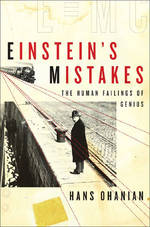
Einstein’s Mistakes


Title: Einstein’s Mistakes – The Human Failings of Genius
Author: Hans C Ohanian
Publisher: W W Norton & Co, 2009 (First)
ISBN: 978-0-393-33768-6
Pages: 338

Albert Einstein is a towering personality in the intellectual landscape of the world of all time. Being a genius won’t ensure a person his place on this coveted setting. Einstein was more than that – he was a physicist of stellar caliber, a philosopher, a humanist, and altogether a great man. At least that was what we had conceived – until we get hold of this book. Ohanian, who is himself a physicist and has written many books on the subject handles the personality and professional career of the great scientist in an incisive fashion. He proceeds by first stripping Einstein of all the sheen generously endowed by an over-eager media constantly on the lookout for a marketable icon and delves into the fallacies and mistakes committed by him – in his theoretical papers and conceptual formulations. Some of his earlier mistakes were mathematical in nature – Einstein was uncomfortable with mathematics. But in an era when physics was reputed to be difficult even for physicists, he couldn’t go on much with his unsure grasp of mathematics. We come across such inadvertent errors in early derivations of relativity theories. Later, he employed mathematical assistants to do the tedious calculations for him. Though the author claims to describe only those errors committed by the genius in his professional capacity, any discussion about Einstein is bound to get tied up in a bit of sensationalism and charisma pervading his person. So we read about his adulterous liaisons and partisan leanings towards the fair sex.

Einstein completed his schooling and graduation in Zurich, Switzerland. After 2 years spent in a futile search for a job, he was accommodated as a third-class clerk in Federal Patent Office in Berne which left him with ample time for his pet theories and research. Though he managed to publish several insignificant papers earlier, the year 1905 turned out to be the year of miracles. He published five original papers in the journal Annalen der Physik, all of which proved to be milestones in the growth saga of physics of all time. His papers included a postulation that light is emitted in discrete packets called quanta (singular, quantum), description of Brownian motion – a random movement of liquid particles due to collisions at the atomic level, special relativity and the energy-mass equivalence – the most famous equation, E = mc2.

Einstein’s relativity principle was first proposed not in so many words by Galileo (1578 – 1642). Elements of references to a relativistic structure can also be seen in Isaac Newton’s magnum opus Principia Mathematica. The real momentum came only in the latter half of 19th century,  when Maxwell discovered the laws of electromagnetism. He observed that his equations yielded a result for the velocity of light which is the same irrespective of the speed of light sources, which was contrary to natural expectation. We observe that if we move in any direction, the object which comes to us with a particular speed will appear to be moving faster than an object receding from us with the same speed. Not so, in the case of light. Lorentz and Poincare developed the idea further, publishing papers on relativity in 1895 and 1904 whereas Einstein published only in 1905. Till the end of World War I, before Einstein’s everlasting fame was not assured with his discovery of general relativity, the principle was known in academic circles as the Lorentz-Einstein Principle. Einstein’s proof of his paper on special relativity (1905) contained several mistakes, some of them related to physical ideas and many of them to mathematical concepts.

Among the stunning revelations made by the author in this book, nothing shocks us more than the assertion that E = mc2 is not an original Einstein contribution! In fact the equation has acquired legendary status owing to associations with him and its contribution to the making of the atomic bomb which devastated Hiroshima and Nagasaki. The author affirms that the equation was known in physics circles several years before Einstein’s attempted proof of it in 1905. J J Thomson, the discoverer of electron had tinkered with it. Einstein’s contribution was the proof of it and in fact it was riddled with mistakes. Max von Laue published the correct proof, followed by Felix Klein. Einstein himself came up with alternate proof over the years, but all contained errors of some kind or the other. That von Laue and Klein didn’t get the credit due to them is one of the injustices of scientific literature. It may also be seen that Einstein had no significant impact on the making of the A-bomb. His letter to Roosevelt urging him to make one citing recent developments in Nazi Germany on the same lines is claimed to have not made much headway in the U.S. Administration. In any case, for nuclear fission, it is possible to calculate the energy released from electric repulsive forces whereas for nuclear fusion, mass-energy relation is the only way. It is curious to note that in Einstein’s autobiography in which he waxes eloquent on his contributions to physics, he is silent on the famous equation. May be he had identified that his grounds for priority is shaky, or else he might have got bored with the long-held association with the equation.

Einstein’s undying fame came with the experimental verification (1919) of the predictions of General Relativity published in 1915. The theory itself was opaque to most people, including prominent physicists and from what is described in the book, it appears that Einstein himself was also unaware of some of the finer nuances. He tinkered freely with the proof of the theorem, and modifying the final statement of it by adding another term called cosmological constant to account for the idea believed to be true at that time that the universe is static. His theory predicted an expanding universe, but to make it static, Einstein added the constant. When Edwin Hubble proved 10 years later that the universe was indeed expanding, a shamefaced Einstein deleted the factor and declared it to be his greatest blunder in life. This fiasco is evident of the fact that the great physicist hadn’t had any clear intuition about what he was driving at. The story didn’t end there. The cosmological constant actually provided for a repellant force at great distances, contrary to gravity which is always attractive. In 2000, observations found that its universe’s acceleration was increasing. This could be accounted for only by adding the factor back into the equation. Physicists term this phenomenon as ‘dark energy’ which is thought to comprise of 71% of all that is in the universe in terms of matter and energy. Fortunately, Einstein was not alive to swallow his words again.

After 1915, when he was 36 years of age, his productivity sagged and no major discovery could be attributed to him. Apart from some occasional sparks of creativity like the Bose-Einstein condensation and Einstein-Podolsky-Rosen Paradox, nothing worthwhile came out. During the last two decades of life, in which he had to flee Germany owing to Hitler’s rise to power, he was absorbed in developing a unified theory of everything, which attempted to integrate electromagnetism and gravity which were the only two fundamental forces known at that time. His papers containing highly abstract mathematical constructs didn’t take him anywhere and as time progressed and Einstein grew old, he was treated as an anachronistic old-timer by his colleagues. He passed away in sleep in 1955 at the age of 76 due to a burst aneurism.

Several glimpses of Einstein’s personal life is also glanced at, in the book. We need not go into the details, except for a brief remark that it was not at all a model for any one. He is portrayed as greedy, having laborious disputes and arguments about his salary. He evaded tax from German authorities by secretly opening an account in Holland and transferring royalties from his publishers to this account. He was a womanizer and having no paternal affection to his own offsprings.

Ohanian’s uncompromising position against superstition and organised religion is commendable. He really loses his temper when narrating the brief biography of Galileo and his ordeals with the Pope and Dominican friars on the issue of whether the sun or the earth moves around on which religion had no locus standi. In confirmity to the iconoclastic treatment of holy or divine authority throughout the text, Ohanian maintains an irreverent attitude to great physicists, like Newton or Einstein. Of course, their contributions are respected and their caliber appreciated, but their weaknesses as human beings is clearly brought out in detail like Newton’s spiteful tricks against competitors and Einstein’s heartless treatment of his first child who was born out of wedlock.

On the down side, the book takes long detours not much relevant to the main topic of discussion like Galileo’s and Newton’s somewhat detailed biographies. Such unnecessary digressions don’t add any specific interest to the argument. On a more serious note, Ohanian’s aversion to use metric units in describing physical phenomena is surprising and abhorrent at the same time. Units of measurement like the mile is expected in an American publication, but unwillingness for using the kilometer is begging contempt from modern readers. Instead of straightaway using kilometer, he employs klicks, which is a term used by U.S. military to denote the same concept. Such American chauvinism is highly deplorable.

Altogether, the book is recommended.

Rating: 3 Star

Sunday, January 13, 2013

Taj Mahal


Title: Taj Mahal – Passion and Genius at the Heart of the Moghul Empire
Author: Diana and Michael Preston
Publisher: Walker & Company, 2008 (First published 2007)
ISBN: 978-0-8027-1673-6
Pages: 284

Taj Mahal is undoubtedly India’s greatest engineering achievement. Built out of an emperor’s sorrow over his dead wife, the white marble mausoleum has been identified as a symbol of India worldwide. The familiar image of the imposing structure on the banks of river Jamuna evokes feelings of awe, wonder, compassion and fulfillment. Influencing the mind of the onlooker is the romantic history of the Moghuls, the only Indian dynasty which could live on in the minds of people of later times through their magnificent buildings and equally magnificent court customs which coloured the imaginations of thousands of poets and story tellers. Most of them were egotistic, megalomaniac and blood-thirsty, resorting to the cruelest methods imaginable to man and which were lavishly employed against their rivals, be them their own brothers, cousins, father or sons. Since the principle of primogeniture was not practiced, the issue of succession in the event of the death of a king always resulted in fratricidal warfare. Unsuccessful princes usually found their eyes gouged out, or if the victor was merciful, they were summarily executed, without adding years of suffering to their lot. Rare exceptions notwithstanding, all of them were pleasure-seekers and ruled roughshod over their hapless subjects. Religious bigotry was practiced during the beginning and end of its flowering period in heartless detail. Thousands of temples were destroyed, thousands and thousands of men and women were taken as slaves or concubines of the rulers and two Sikh gurus were executed. It is clear that the nation does not owe them any moral or social debt for any lasting contribution they had imparted to its society. However, the dynasty still commands attention from us with their tales of intrigue, love and plain cheating.

Diana Preston and her husband, Michael Preston has produced many works under their joint pen name of Alex Rutherford whose book Empire of the Moghul - Raiders from the North has been reviewed earlierin this blog. That was fiction and this one is heavily tinged with details of suspiciously fictional origin. The book begins with Babur’s campaign to India starting from 1526 and nominally covers the end of the dynasty with Bahadur Shah II’s exile to Burma after his fiasco in the first War of Independence in 1857. The heart of the narrative covers Shah Jahan and his rule. Architectural and structural details of the Taj are given in sufficient detail which can be expected from a book targeting general audience. It also describes the changes in appearance affected on the ageless mausoleum after Moghul power waned and authority changed hands, first to British and then to indigenous. The authors have traveled widely in India, Uzbekistan and Iran to visit other construction of similar nature and to compare them to the Taj.

Babur established Mughal rule in India after defeating Ibrahim Lodi at the first battle of Panipat in 1526. That empire was not secure as Babur’s Turkish court couldn’t obtain cooperation from the Afghan nobles who made up the Delhi Sultanates. His son, Humayun was defeated by Sher Shah and thrown into exile. However, he regained his kingdom which grew to gigantic proportions under his son Akbar’s reign which nearly lasted a half-century. Akbar’s eclectic ideals on religion and government helped the various parts of the country to come together in a cohesive way. The sun of Moghul paramountcy rose in Akbar’s reign and probably set at around the completion of Taj Mahal when the empire began reeling under financial stress, caused in no small measure by the great building projects of Shah Jahan. Akbar was followed by his son Jahangir, to whom Shah Jahan was born.

Though Shah Jahan was the favourite son of his father, their relations soured towards the end of Jahangir’s father. In the power struggle which ensued the invalidation of Jahangir, who was addicted to opium and liquor, Shah Jahan killed his brothers Khusrau, Shahriyar and Dawar Baksh, and his two nephews (the sons of Prince Daniyal, his long dead brother). Unlike other Mughals, Shah Jahan was really attached to his wife Arjumand Bano Begum, who was later known as Mumtaz Mahal (the chosen one of the palace) who accompanied her husband in his times of travails – during battles and when he was hounded by an angry Jahangir’s troops for insubordination. In their marital life which lasted 19 years, Mumtaz bore him 14 children, of which 7 died and she herself died in labour during the 14th. The relentless pregnancies must have cost severe stress on the queen’s health which was accentuated by travel through hostile terrain. Mumtaz breathed her last in Burhanpur in Central India in 1630 where they were camped while proceeding for battle with Deccan Sultans in the far south of the country. She was interred in a nearby garden. After Shah Jahan returned to Agra, his capital, he started construction of a mausoleum in deference to the dying queen’s wish. It took 16 years to complete the grand structure which has remained an object symbolizing conjugal love and dedication.

The marble for the structure was brought from Makrana in nearby Rajastan, and the design shows a seamless mix of Hindu and Islamic architectural styles. Built by Indian craftsmen, who skill was appreciated even by Babur, who had found India a dull place in every respect, the monument soon rose to the sky as a mark of human achievement in the unblemished grandeur of the building. Time went on, along with Shah Jahan’s troubles with his own sons, finally resulting in his reaping what he has sowed. His own sons fought among themselves at the first sign of weakness of their father. Aurangzeb ascended the throne after a bloody battle of succession in which he killed three of his brothers, Dara Shukoh, Shah Shuja and Murad Baksh in an inhuman way and eliminating his nephews. Aurangzeb’s intolerant practice of following hard-line Sunni Islam alienated fellow kings who were still ruling over a population predominantly Hindu. Local rulers like the Marathas gained prominence during Aurangzeb’s reign and when he died in 1707, the end of Mughal dynasty was a foregone conclusion.

The book is excellently written with handsome helpings from fiction and hearsay. Though it can’t be relied upon for accurate historical details, the book provides a convenient palette of semi-fictional facts over which historical fact may be superimposed. The authors had done a commendable job in making it a real blend of those two. Handsomely helped with illustrations and photographs of various architectural styles and characters, the work offers a complete panoply of tools for the serious as well leisurely-minded readers. More important of all, it arises an urge to visit the Taj among the readers with its neat description of the events which led to its construction, succinct narrative of the architectural niceties and the comprehensive coverage of his latter history. A good index helps to locate interesting details in a flash. It also provides some lesser known details of the Moghul monarchs such as,

a)      Akbar had more than 300 wives, many from Rajput dynasties, though he gave none of his daughters in marriage to other rulers
b)      Akbar ended the bizarre right of Muslim magistrates to spit in the mouth of Hindus who were late in paying Jizya, the religious poll tax which non-Muslims had to pay. (p.32)
c)      Jahangir possessed 125 kilos of diamonds, pearls, rubies and emeralds alone – amounting to 625,000 karats of gems
d)      Agra in 17th century had a population of 750,000 which was more than double that of London at that time (300,000).

Though not exactly very relevant to the subject matter of the book, it also describes a lesser known fact about Babur, the founder of the dynasty. He was a bi-sexual with his homosexual tendencies evident from his diary (Baburnama) in which he writes about a servant boy who was later came to called Baburi (meaning Babur’s). Babur writes, “I developed a strange inclination for him – rather I made myself miserable over him. Before this experience I had never felt a desire for anyone. Occasionally Baburi came to me but I was so bashful that I could not look him in the face, much less converse freely with him. There was no possibility of speaking coherently” (p.13).

The book is highly recommended.

Rating: 3 Star

Monday, January 7, 2013

The Real Thing


Title: The Real Thing – Truth and Power at the Coca-Cola Company
Author: Constance L Hays
Publisher: Random House, 2005 (First)
ISBN: 978-0-8129-7364-8
Pages: 358

Nothing is more familiar to the world’s younger generation than the fizzy, brown liquid touted as the ubiquitous symbol of energy and vitality – Coca-Cola. Founded in 1886, the company has served many generations of people and has become a legend in business administration. Constance L Hays describes the growth of the company over the years, with special reference to the period after 1980 when changes of a heretofore unseen nature happened and it witnessed its biggest growth dynamics. The book narrates in detail how Roberto Goizueta transformed the company when its sales had plateaued, how Donald Keough and Douglas Ivester steered it through uncharted waters and provided astronomical value for the shareholders. The work ends on a sober note after the grave setbacks faced by the company after 1999 and the silverlining has still not appeared when the book closes at the end of 2004.

Asa Candler purchased the secret formula of Coke from its inventor John Pemberton in 1888. At first, the syrup was mixed with soda water at the point of sale and drank by customers on the spot. Benjamin Franklin Thomas and Joseph Brown Whitehead hit upon the idea of bottling the carbonated syrup so that the product could reach the doorsteps of a larger clientele. At first the company was restricted in its operation to the sale of concentrate to independent bottlers who had the sole responsibility to package and market it. Subcontracting to numerous associates, the bottling industry’s growth was exponential. In 1919, the bottle’s dimensions and look were standardized. The clout of the bottlers was felt too heavy by Coke management soon after. Stuck with a system in which the parent company couldn’t rise the price of syrup, confrontations and legal battles were imperative. However, by the 1980s, more and more bottlers wound up their facilities which were bought or taken over by Coke and its associate, the Coca-Cola Enterprises which was formed to handle bottling business. Though it was technically another company, entrusted with bottling and sales, Coke exerted critical influence in its day-to-day operations as the major stake holder.

The recipe of Coca-Cola is a jealously guarded secret even now. Only a few people even inside the company know the ingredients, a list of which is kept in a bank locker. Analysts have however identified the components from its chemical signatures. When it began in 1886, Pemberton used trace amounts of Coca leaves (from which cocaine is extracted), the flavour of cola nut from Africa, lime juice, vanilla and several other substances in the make up. Cocaine was not regarded as a harmful narcotic at that time, with physicians freely prescribing it for aches and relief. Coke was quick to withdraw the coca content when it was legally untenable to go along with the existing practice. The formula was again changed drastically in 1985 to address the rising market share of Pepsi, Coke’s biggest rival. The initiative was a very bold one to face Pepsi’s challenge which offered a better taste. However, the move backfired when it was rejected outright by the customers. New Coke, as it was known as a replacement of the old one flopped in the market and the company was forced to bring back the old recipe after just 78 days.

Coke always strived to be one step ahead of its rivals, often resorting to dubious marketing strategies. It sought to obtain monopoly rights to get its products displayed in supermarkets and convenience stores. Coke’s tactics of strangling the competitors often went afoul of anti-trust legislations and judgments were issued against the company. In 1996, in a major coup, it stole Pepsi’s bottler in Venezuela to solely do the bottling for them. The latter half of 1990s was however destined to witness the sagging growth of Coke. First the company was sued against by some of its own black employees alleging racial discrimination. It became apparent that the number of blacks in senior management positions was abysmally low when they constituted 15% of the overall workforce. Compounded with it was the recall of product from Belgium, France and some other European countries when it was detected that the carbon dioxide gas used in the bottles was contaminated. It eroded a huge chunk of credibility from the company. In 2000, Coke was forced to fire about 20% of the labour in a vain attempt to cut costs. When the narrative ends in 2004, we get the impression that not all is well at Coke.

The book is a disappointing one. It recounts the history of Coca-Cola mainly from 1980 onwards. Lacking an effective organising structure, the narrative which lacks any interesting feature shuttles back and forth between decades and centuries landing the readers in sheer confusion. Except for occasional flashes of witty comments, the description is drab. The layout is very bad, printed in very small letters and an unappealing font. Altogether, the book is a very unremarkable one.

The book is not recommended for the general reader.

Rating: 2 Star