Friday, June 21, 2013

Whose Bible Is It?


Title: Whose Bible Is It ? – A Short History of the Scriptures
Author: Jaroslav Pelikan
Publisher: Penguin, 2005 (First)
ISBN: 0-1430-3677-7
Pages: 251

No other book has exerted a greater influence on the actions of humanity over the ages than the Bible. Millions cherished it, followed it to the letter, practiced what it preached, died and killed for it. Though everyone would accept that it is the sacred book of Christians, we also find many portions of the collection of books which goes by the name of Bible are sacred to Judaism and Islam as well. It is this affiliation offered by these varied sects that have obtained the sobriquet, People of the Book, to them. This work is a fine effort to explain the origins of Bible, its growth, splits, compilations, the story of its spreading across the world and newer interpretations of it which continue to be of relevance to a great many people. Pelikan is amply fit for the task, as he is the Sterling Professor Emeritus of History at Yale University and is the author of many books, including the five-volume The Christian Tradition – A History of the Development of Doctrine. He has received many professional acclaims, counting also an honorary degree from the Jewish Theological Seminary of America to a total of more than forty honorary degrees. It is no wonder why such a book crossing the boundary of everyday religion should invariably come from a man who is a bridge between religions.

The book begins with an excellent review of how the books of the Bible came to be assembled as the canon or scripture. The history of the Scriptures is handled in fine, professional manner which is appealing to all classes of readers since it contains enough respect for the faithful and enough objectivity for the skeptic. The stories, or events, depending on which way you look at it, described in the Old Testament were handed down through generations by word of mouth. It came to be codified by the first or second centuries BCE. The Old Testament (also called Tanakh) is divided into three parts – the Torah which is the most sacred, consisting of the first five books and forms a canon within the canon, the Nevi’im, which is the deeds and teachings of the prophets of Israel, and the Kethuvim, the writings which were incorporated into the canon at a later date. Scholars differ on the date on which the book was assembled from its constituent parts, as the Greek word biblia means ‘little books’. Pelikan gives a surprisingly later date for the compilation of Old Testament as 90 or 100 CE, but with solid evidence to back the claim. This date is later than the making of some of the books of New Testament. But the author asserts that the fall of Jerusalem in 70 CE and the rise of the Christian movement had goaded the Jewish rabbis to set their scriptures in a permanent way through a synagogue held at Jamnia.

Alexandria in Egypt was a great centre of cosmopolitan learning and commerce in the early centuries of common era. Lot of Jews lived there and thrived. Many of them lost contact with their mother tongue, Hebrew, in which the Old Testament is written. Partly to provide inspiration to this new generation and partly to spread the message among gentiles, the Bible was translated into Greek. Legends says that six scribes each from the twelve tribes of Israel were employed for the work, bringing the total to 72. Hence the Greek Bible came to be called Septuagint. In fact, the Christians made most use of this book, to carry on their own liturgical process at which the Jews were deliberately kept apart. The New Testament, written originally in Greek, was a logical sequence to the Septuagint.

A skeletal form of the New Testament was in use by 150 CE but there was no uniformity in the sequence or selection of books. It was written in Greek as Paul preached his ministry in Asia Minor, Greece and only later was attracted to Rome. Scholars like Athanasius of Caesaria and Jerome was successful in compiling the books of the New Testament in a canonical form by the end of the 4th century. It may astonish us to learn that the books of the Old Testament was finalized and legitimized only a millennium later, at the Council of Trent in 1546. The rising power of Rome and its official language, Latin, was instrumental in bringing about a Latin translation of the Bible, known as vulgate, meaning vernacular. However, the Jews had seen the danger of translating their holy books by now, as the Septuagint, which was a Greek translation was expropriated by Christians. Therefore, the Jewish texts were not translated to Latin with ecclesiastical sanction.

The next big development came with the advent of printing. Gutenberg first published the Bible in 1454-55 in Latin. Revised editions soon appeared everywhere. Desiderius Erasmus’ work in 1505 came out with Greek and Latin authorized versions. The Protestant Reformation spearheaded by Martin Luther and Calvin sought to accord sanction only to the original text in Hebrew or Greek as they mounted a campaign of going back to the Originals. Primacy of place for reverence moved to the Book instead of idols as in Roman Catholicism and Eastern Orthodoxy. A subtle shift in learning of Hebrew and Greek was seen in Reformation clergy. This importance granted to Bible text resulted in a number of interpretations to it and consequent schisms. Bible was translated to several vernaculars in Europe by 16th century, with the German translation by Martin Luther himself. The authorized King James version in English appeared in 1611.

The last two centuries saw phenomenal growth both in the number of copies and number of translations of the Bible. There is virtually no language, nor library on earth in which a copy of the Tanakh or New Testament is not available. However, the last century also witnessed the Holocaust, where Jews who share the Scriptures with Christians were singled out and killed in large numbers for the religious belief they possessed. In the end, all comes to the interpretation and reinterpretations of the books of the Bible which are giving new meanings and aptness to our everyday lives, as the author sums it up.

The book could have done better with an index on account of the lots of esoteric terms and ideas discussed. In its present form, it is very difficult to look up a word later. The language is scholarly, which means there is ample scope for simplification. Long sentences, reaching up to half a page can be seen. This is definitely not a disadvantage, as fine diction is the aspiration of any writer.

The book makes itself endearing to the readers on account of the fine thread of humour intricately woven into the structure of the narrative. It is no mean feat to be humorous while dealing with such a sensitive issue as Scriptures.

The book is recommended.

Rating: 3 Star

Tuesday, June 11, 2013

About Time


Title: About Time
Author: Adam Frank
Publisher: OneWorld, 2012 (First)
ISBN: 978-1-85168-909-5
Pages: 337

First of all I need to say that this book is a bit tough. Books in the popular science genre should not be so difficult to grasp, otherwise people may find it easier to go after Nature or Science, the reputed scientific journals. Frank talks about time and its meaning to the society and to cosmology, the study of the universe. The weight of learned opinion now tilts to the notion that time itself began with the big bang in which the universe originated. This preempts any attempt to ask questions like what went before the bang. What the author asserts is that cosmic time and society’s concept of time are glued together and modified according to improving standards of material engagement. For example, an individual who lived in pre-historic times may find it meaningless and confusing to learn that an event is scheduled to begin at 10.23 am. The methods of time reckoning familiar to his society was based on the movement of the sun and a resolution of a few hours was enough to run the society in good order, but not now. Modern society engages vastly superior elements in time reckoning that a resolution of even seconds may appear to be too long, in some circumstances. The book gives a history of the progress in the idea of time over the ages and also a good description of the theories governing the origin and development of the universe.

All human societies, irrespective of the state of cultural progress they were in, had means of time reckoning that was amply suitable for their purposes. Though it may seem crude to us today, the contemporaries of such primitive methods didn’t feel constrained by any inadequacy of the device. Hunter-gatherers had a measure of time that encompassed the day and the seasons. When neolithic farming and agrarian societies entered the picture, accurate reading of the season in which farming activities like seeding and manuring were performed became very important. Curious it may seem, but these people had an idea of how the universe began and allusions to such immense events are still represented by the myths that had been passed on to modern times. By the time of classical Greece, rationalism made its first halting step into learned discourse. Hellenistic thinkers repudiated the need to invoke divinity into everyday life. Development of calendars to reckon time had its beginning in Mesopotamia where accurate measurements of celestial trajectories of planets was woven into the practice of religion itself. The first systematic attempt to bring out a unified calendar took place in 46 BCE when Julius Caesar modified the existing mechanism to make Julian calendar which forms the basis of the calendar we still use.

Society’s needs for accurate time keeping depends on its material engagement. Frank lucidly explains the development of clocks around 1300s that divided the day into equal parts. The original inventor of mechanical clocks is unknown, but its spread like wildfire ever since its first appearance in 1307 at Orvieto, Italy. Clock work was perfected in a few centuries. Harrison’s naval chronometer set standards in fixing the longitude coordinates at sea. As clocks proliferated, the need to set standards of time between cities became a burning issue. It was pure chaos before 1883 when the railway mediated effort succeeded in proclaiming time zones whereby cities falling within a 15 degree stretch of longitude had a common time. Imagine the trouble when each city had a unique time while the railway had another!

The 20th century saw the marriage of space and time into a single entity and physics finally began to move away from common sense. Einstein’s theory of general relativity established conclusively that space and time does not stand out independently as Newton had thought and that they are merged in an integrated artefact, called spacetime. Likened often to a stretched rubber sheet, the surface of spacetime gets curved due to the presence of matter or energy which causes gravitation. Thus, instead of recognizing gravity as a force, Einstein showed it as only a quirk emerging out of the curvature of spacetime. Development of electronics and computers made the dependence of society more abstract through the ubiquitous silicon devices. Even though the modern communication devices free us from the fetters of space, we are more and more tied up to electronic time set by the schedulers and calendars of the devices.

The book presents a comprehensive discussion on the theories that purported to describe the universe and its origins. From steady state theory in which it was believed that the universe existed at all times, the Big Bang theory gained prominence as it could successfully explain some of the observed facts like cosmic microwave background radiation which other theories couldn’t. Coupled with the developments in particle physics, cosmology entered a new phase in the 1990s. The observation that the universe is expanding more rapidly threw an unexpected road block on big bang theory’s path. Eternal inflation came up as a way of accounting for this effect, but it threw up several problems in its wake on the quantum level. Concept of multiple universes or multiverse which postulates the simultaneous existence of several universes in which ours is only one. Though it may appear far fetched, it helps to explain away the problem of the existence of about 20 constants in the standard model of particle physics which seem to be finetuned for the existence of life. If multiple universes exist, we can always claim that we happen to be in one which is optimized for us! However, these are only hypotheses and have no basis on observation. It is doubtful that such concepts could ever be verified by experiment or observation. We must note here that one of the basic requirements of a scientific theory is that it should be falsifiable by tests.

Frank is a professor of astrophysics and his arguments on history and culture are borrowed from other authors. Readers are forced to note the very small number of authors he has relied on. Such references are thematic and excessive reliance on other sources make the reading a bit tedious and purposeless. Readability of the book waxes and wanes over the chapters. I’m sure the somewhat dull stuff with which he begins the book must have caused a sizeable loss of readers. However, the diction improves by simplifying as one moves on and even becomes enjoyable at some points in the middle.

The discussion on cosmological models is very comprehensive, but not original – not in the sense that it is plagiarized. The theories could be gleaned from any popular science book which is far more readable than this one. Throughout the book, the author maintain that cosmic time and cultural time are somehow braided together, but not amount of nitpicking has been effective enough to establish it conclusively. Arguments are numerous, but not convincing enough!

The book is recommended only for serious readers.

Rating: 2 Star


Friday, May 31, 2013

In Xanadu


 Title: In Xanadu – A Quest
Author: William Dalrymple
Publisher: Penguin, 2004 (First published 1990)
ISBN: 978-0-143-03107-9
Pages: 302

Dalrymple is always welcome for an Indian reader. Most of his books are on Indian topics or very much related to its ethos in a subtle way. In fact, he enjoys a rather high level of tolerance from desi readers as against many western authors when they go on a critical assessment of the experiences they had had in this country. Dalrymple do present many of his experiences in a not too flattering light, but the recounting will be in such a caressing way that not even overly sensitive people get offended by it, as they can clearly see the love and affection the author possesses towards this ancient nation. However, the present book is the very first one from the author’s able hands and depicts his journey across the breadth of Asia, retracing the footsteps of the 13th century Venetian merchant, Marco Polo from Syria on the west to Xanadu (Shang-tu) in the east of China. The journey covers 19000 km mostly across deserts and arid zones of Central Asia amidst a string of neighbouring countries hostile to each other or actually at war. Polo had undertaken the trip obliging a request from Kublai Khan, the grandson of Genghis Khan, who established Mongol rule over most of Asia. Kublai Khan requested religious philosophers from the Pope and in a bid to proselytize the emperor, Polo obtained a sample of oil from the lamps glowing in the Church of Holy Sepulchre in Jerusalem so as to present it as a relic. Even this little detail was noted and copied by the author before beginning his own version of the epic travel.

Polo began the trip in 1271 with the oil sample and Dalrymple illuminatingly point out the profane activities and inter-church rivalries between various congregations which are allowed to offer services at the Holy Sepulchre. He notes with amusement at the irreverence of the young prefect entrusted with topping up of oil in the ever-glowing lamps from which he managed to obtain a small quantity. He declares that there is nothing magical in the oil, that it is ordinary sunflower oil and passes some lasciviously oblique comments about the author’s lady companion, even while inside one of the holiest shrines of Christianity. This is also one of the factors which led the author to claim that for 2000 years, Jerusalem has brought out the least attractive qualities in every race that has lived there. The holy city has had more atrocities committed in it than any other town in the world (p.18). These remarks apply equally well to any holy city of any religion.

Polo traveled from Jerusalem to Syria on his onward journey, but that is unthinkable in today’s Middle East. If Israeli visa is stamped on the passport, Syria and Iran will not let you through. So the author and his friend went back to Cyprus and boarded a ferry to Syria. He describes with a high sense of humour his travels along pot-holed roads of Turkey and marvels at the civilizational progress it had obtained in the middle ages. The Shifaiye Medresse was built in 1217 as a medical school and there was nothing remotely comparable in Europe at this time, even the outstanding Italian medical school at Salerno. European architecture, or many facets of it, like the pointed arch which is a key feature of Gothic style is derived from Islamic architecture.

Traveling in 1986, while the Iran – Iraq war was raging and amidst a xenophobic Persian mindset nourished by the revolutionary mullahs, journey through Iran proved irksome to the author. Professing strict adherence to medieval dogmas and codes of practice, both him and his girlfriend found Iran to be rigid, playing mullah’s speeches in public transport systems and irksome for women. It is however, to be noted that the people were as friendly as any other and helpful, though the author finds them to be possessing a tinge of effeminacy (p.162). Polo’s route turned to Afghanistan from there, but it was inaccessible to Western tourists because of the Soviet occupation of the country and the vast minefields they had set up on the border regions. Instead, they traveled through Pakistan towards north to catch up with the ancient caravan route.

The traveling party was put to great trouble by the intricate rules of Chinese bureaucracy. Most of the route through which they traveled was strictly off limits for foreigners in 1986. Local police harassed them and arrested them on more than one occasion. Dalrymple humorously narrates how they managed to hoodwink the not-so-alert policemen and continued their travel by hitch hiking, too afraid to use public transport. Such foolhardy acts of defiance was bound to end up in long prison sentences in undemocratic countries like China, but the author and his readers were fortunate enough to survive to tell and hear the story. China seems to be justified in taking such precautions as the route coincided with one of China’s nuclear testing sites and the author claims to have observed people suffering from harmful effects of radiation. The veracity of the claim could not be proved however. The team experienced their greatest despair when they were again arrested near Shang-tu (Xanadu, in Coleridge’s poem) – their final destination. Having come 19000 kilometers, only to be arrested and deported just 8 km from the ruins of Kublai Khan’s medieval palace was heartbreaking. The police took pity on them and transported them to the ruins in their own vehicle, but didn’t allow to photograph the place. Dalrymple managed to pour the oil he’d collected from Jerusalem over the ground where the Great Khan’s throne was supposed to stand.

The author gives a little too much attention to finer details of architecture whenever he is near a dilapidated structure, whether it is a disused mosque, damaged Medresse or a caravanserai. He is quite adept on the nuances of architecture and delights in presenting the similarities and contrasts between various schools of architecture, which is not so close to the hearts of readers.

Dalrymple is so adroit in delightful depictions of travel experiences, and his narration of travel in China in 1986, the year in which he actually traveled there, is quite revealing by comparison with today’s realities. Beijing was still a city of bicycles when they reached there and its transformation to a bustling metropolis is mind boggling. Perhaps if the author would care to retrace the entire journey and note the changes alone, that itself would prove to be another classic in travel writing. The book contain a set of monochrome plates of sights on the way and is graced with a good glossary.

The book is highly recommended.

Rating: 4 Star

Monday, May 27, 2013

The Weight of a Mustard Seed


Title: The Weight of a Mustard Seed
Author: Wendell Steavenson
Publisher: Atlantic Books, 2009 (First)
ISBN: 978-1-84354-305-3
Pages: 302          

A good work that narrates the ravages of Iraq first under the cruel tyrant Saddam Hussein and later serving as the battleground for rival militias to settle their internecine scores. Wendell Steavenson has worked for Time and written for a variety of publications. She lives in Paris and is the author of the acclaimed title, Stories I Stole. In an insightful illustration of Iraq’s disastrous slide towards autocracy and then anarchy, first under a tyrant who deserves no better epithet than a brutal tribal warlord and then under a foreign government which foolishly thought that their own brand of democracy could be implanted everywhere else with ease. The book recounts the life of Kamel Sachet, a General in Iraqi army, then the governor of one of its provinces, a deeply religious man who had built three mosques in Baghdad out of his own income and later a victim of Saddam’s mindless purge. The author has brilliantly caught and exhibited the spirit of an age in which Iraq declined on all parameters of civilized society.

Iraq is an unlucky nation, if I may pass a judgement. It is rich in history and heritage. The cradle of civilization was not confined to Egypt alone, it extended up to the shores of the rivers Euphrates and Tigris. Home to some of the world’s oldest civilizations, it led humanity on the path towards Rule of Law. Hammurabi’s Code was a pioneering effort to establish a set of rules on which a society could be governed. It offered a conceptually fresh alternative to despotism. Also, the country holds vast deposits of oil, enough to catapult the Arab nation to one of the richest ones in the world. But, just look at its present state! Contrary to its glowing heritage, it was always under oppressive dictators who ruled roughshod over the society. Having no need to keep up even a semblance of accountability to the silent public, those tyrants locked the country in ridiculous wars from which it suffered terribly. International sanctions and terrorist bombings had put a question mark on the marketability of its oil resources.

The Baath party assumed power in 1968 after several coups and struggles had thrown out its weak monarch in 1958. Saddam Hussein emerged as the strong man of Baath party and assumed presidency in 1979. In a very brief time, he cast his dark shadow of autocracy on every division of governance. Though written as a loose biography of Kamel Sachet, the book effectively portrays a cross-sectional view of Iraqi society in those troubled times. Eager for power and glory – the deadly combination which had hastened the end of many a monarch – Saddam attacked Iran, hoping to cash in on the state of confusion after the Shiite Islamic Revolution of Khomeini and the ill will it generated in the western world, owing to the infamous hostage crisis. Iraq could manage some wins in the initial stages, but a determined Iranian society fought back and inflicted heavy losses on the Iraqi side. A desperate Saddam sued for peace after eight years of futile war which went on in a bloody stalemate. The economic repercussions were immense. Saddam had prosecuted the war with handsome bailouts from Kuwait, which demanded the money back since the war was over. A slump in oil prices meant Iraq couldn’t repay. Blind with irritation at the haughtiness of a country which most Iraqis deemed to be one of their provinces, Saddam invaded in August 1990, which later proved to be his undoing. Coalition forces led by U.S. wiped them off from Kuwait and Iraq was put under crippling sanctions till 2003. Saddam’s Air force was not even allowed to fly over most of the country’s airspace. In 2003, U.S. provided the coup de grace in a ground attack which captured Baghdad. Saddam was caught hiding in an underground hole and hanged after due judicial process. Iraq slipped into civil war as warlords and militias, long held in the iron fist of Saddam stepped in to fill the vacuum.

Kamel Sachet, the General whose life story is drawn in the narrative, rose from humble backgrounds but went on to assume some of the highest positions in the Saddam regime. He was obedient to authority, loyal and deeply religious. He fought valiantly in all the Saddam wars and assumed governorship of Amara province after the Gulf War. But efficiency and loyalty were not enough to survive under Saddam Hussein. He demanded and usually obtained unflinching slavery from his followers. He would arrest some of them on quite flimsy charges, lock them up, torture them and subject them to prison sentences. At the end of the term for short sentences or in the middle of it if it was long, he would pardon them and reinstate or promote them to new positions. The officers then would remain steadfastly loyal to the dictator. Sachet also had to undergo such deprivations, but he assumed some kind of autonomy after the Kuwait debacle when Saddam’s authority was seriously challenged. Saddam had him shot at Abu Ghraib prison in 1998.

Steavenson portrays in realistic tones the state of fear and distrust which permeated Iraqi society under Saddam’s rule. Even their private talk was self-censored since the agents of the secret police were everywhere. The author has depicted a true portrait of Iraq during and after Saddam. We need not look any further to see why the toppling of Saddam failed to produce a durable government in Baghdad. The Iraqis are too divided on tribal and religious lines and propped up by a strict code of honour that demands revenge for even the slightest transgression – whether actual or perceived – that when the master who lorded over even their thoughts was gone, the numerous groups and warlords took the country in their own hands. The failure of Americans to fully grasp the basic nature of an Arab society had also helped create the mayhem.

The title of the book is truly an eye-catcher. It is inspired from a Koranic verse which describes the impartiality of verdict on the final day of judgement. Justice is said to be delivered without the bias of even the weight of a mustard seed. The author, banking on her wide ranging connections of friends and acquaintances has widely traveled in the region and conducted interviews with so many people that the book is really a true mirror of Iraq under Saddam and immediately after his end.

The book is recommended.

Rating: 3 Star

Tuesday, May 21, 2013

The Last Secrets of the Silk Road


Title: The Last Secrets of the Silk Road
Author: Alexandra Tolstoy
Publisher: Profile Books, 2004 (First published 2003)
ISBN: 1-86197-379-9
Pages: 210

Alexandra Tolstoy is a relative of the world famous author Leo Tolstoy. She had studied Russian in England and spent a decade working, riding and traveling in Russia and Central Asia. She specializes in riding tours around Uzbekistan and the present book is her reminiscences of an epic journey with three of her friends. The all-girl team took to the ancient Silk Road running from Merv in Turkmenistan to Xian in China, over a distance of 8000 km and in eight months’ time. To relive old times, the team traveled the entire distance on foot, horse and camel copying the legendary travels of ancient times, like those of Marco Polo and Hsuen Tsang. The brave and sturdy group conquered three great deserts, the Kara Kum, Taklamakan and Gobi during their eight-month trip carried out in 1999. Though assisted by a backup crew following in trucks and well connected by a satellite telephone, the journey of epic proportions is indeed a truly remarkable act of courage, dedication and determination. The trek went through four countries, Turkmenistan, Uzbekistan, Kyrgyzstan and China of which the last formed the bulk of travel owing to its sheer size.

The first leg of the journey through picturesque idylls in Central Asia through the three former Soviet republics was quite enjoyable for the team. Even though the journey was planned during the months of May – June, the weather was generally cold and appealing, even in deserts. Their guides and camp managers were cordial and cooperative, providing the team some respite from the very hard regime of living on the roads. The hilly terrain, interspersed with small rivers and trees present the picture of an earthly paradise compared to what was to befall on them in China, the largest stretch of the journey. Tolstoy notes with ardour the lonely wildernesses of Kyrgyzstan, whose natural beauty is not tarnished after the fallout with Soviets in 1991. Other Central Asian states like Uzbekistan embarked on a belligerent nationalistic campaign to support their claims. Kyrgyzs didn’t follow the line and still exhibits a benevolent face to Russians, their old masters. Attempts to whip up nationalism in a tribal society has not yet borne fruits. The team enjoyed the Central Asian stretch of the voyage more than the Chinese section, partly due to the fact that they could ride horses on this leg of the journey. Even though the physique and stamina of Central Asian horses are legendary, we are left wondering at the very poor quality of animals provided for the team.

The second leg of the journey in China was very tough on both the terrain and the poor performance of the crew in the backup team. Being a centrally planned economy, there was no aspect of the journey in which a government-owned company didn’t take part. This caused many hardships for the team whose basic amenities were sometimes not fulfilled because it happened to be a holiday for the company which was entrusted with it. The crew were discourteous at most times and pilfered the funds allocated for travel by forcing the team members to compromise on quality. The author notes with concern at the ease with which officials (including police) in China could be made to bend to one’s wishes with a small bribe. Crossing the Taklamakan desert was the toughest part of the expedition whose problems were complicated by the indifference of the crew. Tolstoy ruefully notes that when they reached the final destination, they were not sorry to bid farewell to the crew and the feeling was mutual.

The book lacks any merit for serious reading. Even though the title is greatly embellished with references to secrets of the Silk Road, the tour was poorly conceived and haphazardly executed to have any impact. There are absolutely no references to history of the road and the times, which tells on the author’s caliber and her lack of homework. The attempt to relive Marco Polo’s travel by riding on horses and camels seemed to be preposterous as there were no efforts to anchor the narrative firmly on the rocks of history. It felt as if the travelers went on a futile trip to the ends of the earth for no more valid reason than a fad. Tolstoy miserably failed to instil in the reader any sense of being part of a great adventure. Copying details of the traveling girls’ quarrels and diaries does not bid well for interesting reading.

The book contains a few colour plates of the journey. However, they don’t have sufficient clarity to offer a flattering illustration of the majesty of the countryside through which the expedition lumbered on. The book also don’t do justice to its grandiloquent title due to lack of serious research.

The book is not recommended.

Rating: 2 Star


Thursday, May 16, 2013

Ambani and Sons


Title: Ambani & Sons – The Making of the World’s Richest Brothers and Their Feud
Author: Hamish McDonald
Publisher: Roli Books, 2010 (First)
ISBN: 978-81-7436-814-0
Pages: 382

Reliance Industries is India’s largest and most profitable company in the private sector. Built by Dhirajlal Hirachand Ambani (Dhirubhai) from scratch, the enterprise struck deep roots during India’s License-Quota-Permit raj. When the economy opened up, he could build on the groundwork he’d already prepared and the company rapidly grew into one of the most profitable ventures in the world. Dhirubhai’s murky dealings in cornering plum government allocations and excluding his business rivals is the subject of the author’s controversial book, The Polyester Prince, which is officially banned in India though e-books can be freely downloaded from the web. However, this work is free of contentious issues in the sense that the author has applied brakes on his investigative drive so that it could be sold in India. Details of several clandestine and unethical deals are given of course, but the consistent refrain is that none of these would have been needed if India had practised an open-market, free-enterprise policy which it adopted in the last decade of the past century. The book is indeed a good read.

Dhirubhai was born in Kathiawar, Gujarat in 1932. After completing his high school education, he was forced to look for work, prompted by the very small income of his father, who was a school teacher. Belonging to the Bania caste, he had extensive contacts rooted on caste lines with merchant communities worldwide. He was employed by a merchant firm in Aden, Yemen where he worked as a salesman for Shell products, garnering a slew of business contacts across the Red Sea littoral and East African ports. Aden was a busy British port-town in those times, similar in stature to Singapore. His business acumen and risk taking was phenomenal. It is said that he used to buy up Yemeni silver rials which had more metal in it than the prevailing exchange rate with pound in order to melt it to make silver ingots for trading. In 1958, he was back in India, looking for business opportunities which saw the birth of Reliance Commercial Corporation which traded spices and textiles for export to the Middle East and East Africa.

At that time, India was standing mute witness to one of the most ridiculous exercises in centralized planning and bureaucratic control on business ever imposed on a democracy, but clearly modeled on authoritative communist regimes. Nehru and later his daughter, Indira Gandhi, both prime ministers, thus paved the way for inefficiency, nepotism and corruption to saturate decision-making machinery of the government. Those industrialists who had friends or bribe-takers in positions of power to pull strings greatly benefited from this sorry state of affairs. It is often said that Ambani didn’t engage in illegal activities. He simply changed the rules when it best suited him through his extensive connections at the right places. In its frantic bid to earn foreign currency, Indira’s government was willing to go to any illogical extreme. Ambani exported cheap nylon fabrics at elevated prices to free ports which languished and later got damaged there. But, based on the calculated value of exports, he could import polyester filament yarn (PFY) which attracted huge margins, nearly reaching 600%. The scheme was of course, open to every one, but Dhirubhai saw it first. When the others too got wind of it, the margins naturally fell.

McDonald identifies and explains Reliance’s expansion phase in the 1980s. After Indira Gandhi’s death in 1984, Ambani’s plans were thwarted by Rajiv Gandhi’s initial enthusiasm at fair governance. This was in sharp contrast to that of his mother, who had pushed corruption to the centre-stage of Indian administration through her ruinous measures of stifling bureaucratic control of every aspect of the economy. But when Rajiv himself was later bogged down in accusations of corruption, notably in the Bofors gun deal, he changed track and Dhirubhai entered his good books. Together, they hunted down Nusli Wadia of Bombay Dyeing, who was Ambani’s business competitor and the Indian Express, which unleashed a tirade against corruption through a brilliant correspondent, S. Gurumurthy. Ambani had a powerful opponent in the figure of V P Singh, who was Rajiv’s finance minister. Singh ordered several inquiries into cloudy deals, but soon lost favour with Rajiv who slowly became the unwitting victim of the machinations of a coterie around him.

V P Singh’s election victory in 1989 brought in a difficult time for Dhirubhai, but it didn’t last long. The author has finely summarized the deals that brought him down in 1990 - the Mandal and Masjid issues. Narasimha Rao’s reforms policy brought in a revolutionary change which wiped away most of the roadblocks put by an over-enthusiastic officialdom. Reliance’s growth was huge by any standards in the last decade of the century. Ambani’s death in 2002 soon forced the simmering tension between the brothers to break out in public. A settlement was reached in 2005 and a conciliatory partition of assets was enforced. McDonald ends the book with a reminder that it has reached a pause in the story, to which the not-so-old brothers and their unbridled energies could in future provide fertile grounds for more juicy anecdotes.

McDonalds’s lack of awareness of social realities in India makes itself felt at many places. Extravagant claims like Reliance made or broke many prime ministers may be written off as inevitable loud mouthing, characteristic of a book of the genre. But on other issues, the author is not knowledgeable enough to pass comment. When narrating the antecedents of S Gurumurthy of Indian Express, it says “He was the product of a Brahmin family near Madras and was blocked from university by Tamil Nadu’s policies of favouring lower-caste students” (p.124). Coming from Australia, which has one of the worst cases of economic and social repression of the indigenous aboriginal communities, McDonald may be forgiven for not fully grasping the measures of social justice put in place for the lower castes, whose condition was much worse than Australia’s aborigines. The reservation is not 100 per cent and if Gurumurthy was smart enough to come on the top 30-40%, he could’ve attended the university. Presumably, he was not bright enough!

The book presents a picture of continuous economic liberalization measures starting from 1980 onwards whereas we normally credit P V Narasimha Rao for initiating the reforms in 1991 which catapulted India to the world’s fourth largest economy in purchasing power parity. What we read from the book is that the pace was so gradual at first that it was not felt. However, there is sufficient proof from the pages that Rao and Manmohan’s reforms were anticipated very early on and all the prime ministers of the period, Indira, Rajiv, V P Singh and Chandrashekhar followed it even if with some demur.

The book is recommended.

Rating: 3 Star

Sunday, May 5, 2013

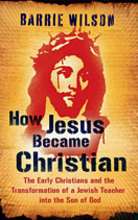
How Jesus Became Christian


Title: How Jesus Became Christian – The Early Christians and the Transformation of a Jewish Teacher into the Son of God
Author: Barrie Wilson
Publisher: Phoenix 2009 (First published: 2008)
ISBN: 978-0-7538-2579-2
Pages: 284

A good book written with much moderation and backup research in contrast to the provocative nature of the title. Religion is an avenue of human venture where study of early history is not entertained. The faithful follow the priesthood whose imprimatur substitutes reason. But scholars and objective students of early history of the church feels a vacuum between the time when Jesus preached in Judaea and the Christian church was established, covering the first 350 years of the Common Era. This book steps in to fill the vacuum with comprehensive coverage of events and personalities who defined the new religion and pioneered its way in the turbulent centuries of the early Christian era. Barrie Wilson is eminently suitable for the task, being the Professor of Humanities and Religious Studies at Toronto’s York University. He is an award-winning educator and teaches courses on early Christianity, the Dead Sea Scrolls and Second Temple literature. He is the author of a number of academic books, but this is his first book for the general reader. But the simplicity and clarity of detail showcased in the book belie the fact that this is his first work for the lay man. The book spans seven hundred years of history of eastern Mediterranean from 300 BCE to 400 CE.

Alexander the Great was the single most influential character in history who changed the course of it. His campaigns caused Greek civilization to spread on the eastern and southern shores of the Mediterranean. City states on the model of Greek ones like Athens and Sparta sprang up which accommodated a cosmopolitan society practicing multiple religions, most of them polytheistic. Unlike the Jews of Israel, those religions showed a spirit of assimilation and cooperation towards Hellenization, which found the monotheistic Jewish community making sacrifices to get along with the foreigners in their midst and who ruled over them. Such non-Jews were called Gentiles, a disparaging term among pious circles. The strict dietary and social customs and unrelenting demand for allegiance to a single god created tensions in the community. Four major factions originated out of the necessity to wake up to challenges. The first one, Sadducees were wealthy priests and accommodated the wishes of their occupiers – the Greeks at first and Romans later – often by forcibly suppressing claims of would-be Messiahs who sought to obtain deliverance from foreign yoke. The second party, Pharisees concentrated on education by which religious values were imbibed. The Essenes, a community which withdrew from the society to found closed networks on the Dead Sea coast were hardliners. The Zealots were the most passionate about keeping the Jewish spirit alive and resolved to fight the occupiers whenever events presented an opportunity.

Judaism fervently hoped for a Messiah in these turbulent times who would overthrow foreign rule, establish an independent Jewish state, become the Davidic king, usher in an era of universal peace and establish the kingdom of God. The wicked would be eradicated and the righteous dead would be resurrected to a stretch of eternal life. Those who are living and faithfully follow the Torah (the first five books of Old Testament) would also have immortality. Such was the grand scheme of things envisaged by an increasingly desperate Jewish people. Wilson presents a well-researched argument that Jesus was an ultra orthodox Jew who taught rigorous practice of the Torah. Clear and varied quotations from the gospels are furnished to support the claim. While we get a general impression that the argument may hold generally, it appears that Jesus’ attitude to many points of the religious law, like observance of Sabbath was liberal, thus negating the author’s chain of reasoning. Jesus promised a new state, a kingdom of God which would materialize in his own lifetime in which he would become king. Jesus’ triumphant entry into Jerusalem mocking marks of royalty was exactly to convey the message. The Sadducees, backed by Roman troops were not amused at this political affront to Roman order, the Pax Romana and had him crucified. His disciples were disappointed at the kingdom not arriving, then hoped for Jesus to reappear and proclaim it.

James, who was one of Jesus’ own brothers, headed the Jesus Movement in Jerusalem. They were thoroughly Jewish, who saw Jesus in flesh and blood. Their conception of him was as a mere mortal, having no divinity, no virgin birth and no resurrection, but a great Rabbi chosen by God. Their descendants continued for more than a century under the title of Ebionites and Nazareans. Meanwhile Paul, who also was a Jew, but not rigorously following the Law began preaching a Christ Movement among the gentiles, mainly in areas now in Turkey. His disciples were reluctant to follow the 613 injunctions in the Torah required to be followed by the faithful, including male circumcision, dietary strictures, observance of Sabbath and others. Paul’s Christ was a saviour figure appealing more to Romans than the historical Jesus who was only a Jewish Messiah claimant. His followers needed to practice the simpler Noahide laws which were only seven in number. However, his movement needed to possess the authority of antiquity to claim and obtain legitimacy in the Roman world which venerated ancient objects and beliefs. That link was provided by the Book of Acts of the Apostles, which the author says was penned by Luke, the gospel writer. It fused the Jesus and Christ movements into two arms of a common movement when in fact both the groups exhibited characteristics of different religions. Wilson goes on to claim that around the end of the first century, the present sequence of books of the New Testament emerged, but they are not arranged chronologically. The epistles of Paul are the oldest documents in the collection, followed by gospels of Mark and Matthew, then by Luke, Acts and finally John. Eventually, Paul’s Christ Movement was transformed into modern Christianity while Jesus Movement petered out. Paul also established that belief in Jesus Christ was the only requirement expected of a follower who need to obey Torah.

Pauline Christianity, embellished with Greco-Roman mythology, gained converts and became very strong in the 2nd century. Virgin birth and resurrection was two of its cornerstones. Wilson presents several examples from other theologies of the time where virgin birth is resorted to. These include Attis (a god and virgin mother Cybele), Pythagoras (god Apollo and human mother Parthenis), Caesar Augustus (god Apollo and mother Atia), the Persian religious figure Zoroaster and many more.

Wilson’s message is loud and clear. We read that “Jesus never converted to another religion. Nor did he start one. If he were to return, he’d probably be amazed – perhaps bewildered or possibly even angry – at what has been created in his name” (p.72). The author alleges that Paul and his followers were partisan to a Jesus Cover-Up program in which the human Jesus was erased out of the text and supplanted with a  god-human, dead-resurrected Christ. Those Jews who saw him practicing in their midst and who were aware of the great chasm developing between them and Paul’s Movement opposed it. The Proto-Orthodox (early Christians) abhorred the presence of Jews who could blow up their cover. Wilson thus identifies the origins of still pestering antisemitism in Christian texts to this feeling of confusion and guilt at having usurped the Jews of their heritage.

The book definitively possess an air of belonging to one of the genres of conspiracy theories. The author is passionate about the concepts which he deems to be true, but fails to account for even some straightforward inconsistencies. He argues that Paul divorced the ideals of his new religion from Judaism to align it with Greek/Roman mystery cults, so as to win converts and to assimilate it into Hellenization. But this argument fails to explain the antagonism it met at the hands of Roman emperors who suppressed it mercilessly until Constantine converted to it in 310s. The book fails to convincingly present the reason for this antipathy if Paul had so disguised it as a Greek cult.

The author assumes the historicity of Jesus as authentic, even though there are disagreements among scholars in this regard too. The book is equipped with a nice timeline and glossary, but the author’s insistence on the use of terms like A.D. and B.C. instead of the secular C.E and B.C.E diminishes its claims to scholarly authenticity. Even though littered with weak arguments stemming from conspiracy theory, it however collects some novel arguments which would attract readers’ attention.

The book is recommended.

Rating: 3 Star